What’s Inside
- Glass Containers Are Essential For Meal Prep Vegetarian Success
- Master The Art Of Undercooking Your Veggies
- Prioritize Real Plant-Based Protein Over Fake Meats
- Cool Your Food Completely Before Sealing
- Batch Cook Your Grains For Easy Meal Prep Vegetarian Bowls
- Pre-Portion Your Sauces To Save Soggy Salads
- Lean Heavily On Frozen Vegetables For Convenience
- The Paper Towel Trick For Delicate Greens
- Embrace Pea Protein Isolate For Stable Smoothies
- Weekly Planning Beats Decision Fatigue Every Time
- Build Around Budget Staples And Reheat Properly
Last Tuesday at my kitchen island, I opened a plastic tub of three-day-old zucchini noodles and nearly gagged at the sour, swampy smell. Figuring out meal prep vegetarian style took me years of soggy salads, mushy tofu, and wasted groceries to actually get right. I tried doing this wrong for months before figuring it out. You can’t just throw raw vegetables into a cheap plastic bin and expect them to taste good on Thursday. It simply won’t work. The textures degrade, the flavors mute, and you end up ordering a twenty-dollar pizza because your prepped lunch looks completely unappetizing. I’m here to share exactly how I fix these disasters. I’ve ruined enough lunches so you don’t have to. I’m sharing the methods I personally swear by for keeping plant-based food fresh, crunchy, and actually edible all week long. Whether you’re a seasoned cook or a total beginner, these tricks will change your Sunday routine.
1. Glass Containers Are Essential For Meal Prep Vegetarian Success

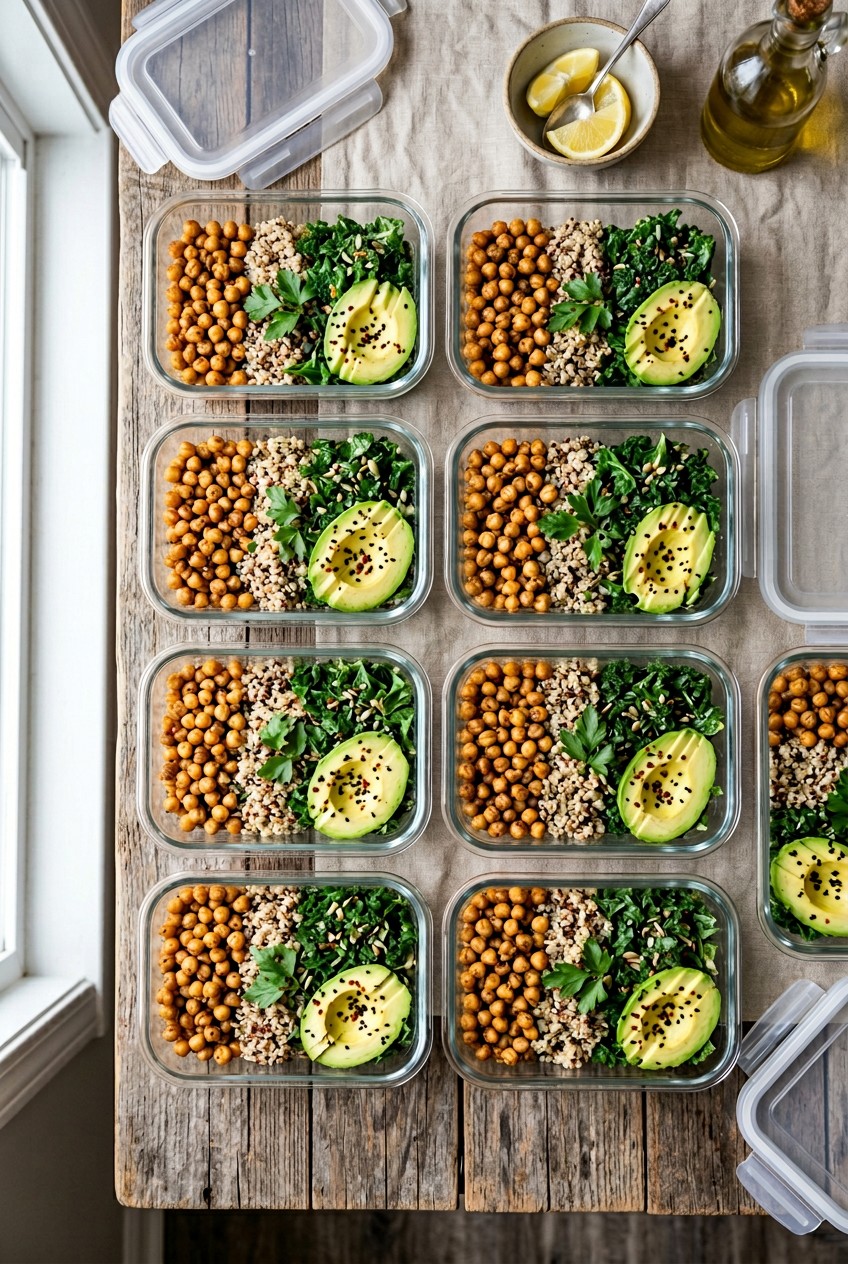
I can’t stress this enough. You need to invest in quality glass containers for longevity and safety. I used to buy those flimsy plastic tubs from the dollar store. Last year, I packed a beautiful yellow curry into a plastic container. By Wednesday, the plastic was permanently stained neon yellow and smelled like stale cumin for the rest of its short life. It’s a mistake I won’t make again. Glass prevents chemical leaching and staining, ensuring your food tastes fresh and is safe to reheat. I personally swear by the Pyrex 10-Piece Glass Food Storage Set. You can grab it for exactly $34.99 at Target. The thick glass feels heavy and premium in your hands. The lids snap on with a satisfying click that tells you the air is fully locked out. If you’re feeling fancy, the Caraway Ceramic Food Storage Sets are gorgeous. A 17-piece set will run you about $245. Honestly, they’re beautiful but heavy. I dropped one of my glass bowls on my tile floor last month and it shattered into a million pieces. That’s the one honest negative about glass. You have to be careful. But the trade-off is worth it. Your roasted sweet potatoes won’t taste like the ghost of last week’s garlic pasta.
2. Master The Art Of Undercooking Your Veggies

Most people get this wrong. A common mistake is overcooking vegetables during your initial Sunday prep session. I used to roast my bell peppers until they were completely soft and blistered. When I microwaved them on Wednesday, they turned into a sad, watery mush that ruined my grain bowl. It’s better to slightly undercook them. This is especially true for high-moisture options like zucchini, eggplant, or mushrooms. Pull them out of the oven a few minutes early. This allows them to finish cooking when reheated, keeping a crisp-tender texture instead of becoming mushy. I buy the Trader Joe’s Organic Zucchini for $2.99 a pack. I slice them into thick 1/2 inch rounds. I roast them at 400 degrees for exactly 12 minutes. They still have a slight crunch when I take them out. Another huge mistake I made for years was salting my zucchini before roasting. Don’t do this. The salt pulls all the water out and boils the vegetables on the hot cast iron pan. Always salt your high-moisture vegetables after roasting. It keeps them firm and prevents that dreaded puddle of water at the bottom of your glass container.
3. Prioritize Real Plant-Based Protein Over Fake Meats

Don’t fall into the common trap of neglecting protein in your vegetarian meals. When I first started eating plant-based, I lived on plain pasta and wilted spinach. I was constantly starving and tired. You’re going to crash hard by 2 PM if you don’t build a proper plate. Aim for 12 to 25 grams of protein per serving. I stopped buying those ultra-processed fake chicken strips. While convenient, many vegan or vegetarian products are highly processed, high in sodium, or contain hidden sugars. Plus, they taste like wet cardboard. Skip the fat-free stuff and the weird soy isolates. Instead, focus on whole, unprocessed plant foods. I buy Whole Foods 365 Organic Quinoa for $4.49 a bag. It gives you 8 to 9 grams of protein per cooked cup. If I need a heavier protein hit, I reach for seitan. You get a massive 12 to 25 grams of protein per 3.5 ounces. I slice it thin and pan-fry it in 1 tablespoon of olive oil until the edges get crispy and brown. The texture is satisfying and chewy. It holds up beautifully in the fridge for four days without getting weird or rubbery. You might also like: 15 Brilliant Good Meal Prep Ideas That Changed Everything

8 Pack 36oz Large Glass Meal Prep Containers with lids
8 Pack 36oz Large Glass Meal Prep Containers with lids punches above its price — 866 buyers rated it 4.5 stars. I would buy it again.
4. Cool Your Food Completely Before Sealing

This is the least glamorous tip, but it changed how I prep forever. Cooling your food completely before storing is mandatory to avoid condensation and spoilage. Sealing hot food traps steam. That steam turns into water droplets on the lid, which then rain back down onto your crispy tofu, ruining the texture entirely. Always allow cooked meals to cool for 30 to 60 minutes at room temperature before covering and refrigerating. I learned that the hard way. I once sealed a batch of steaming hot black bean chili. Because I trapped the heat, it didn’t cool down fast enough in the fridge and actually started fermenting by day three. It smelled like sour beer. You must ensure food reaches refrigerator temperature within 2 hours to prevent bacterial growth. I highly recommend keeping your refrigerator at 40 degrees Fahrenheit or below for optimal food safety. I bought a simple Taylor Fridge Thermometer at Walmart for $5.88. I keep it right on the middle shelf. Regularly check your refrigerator temperature. Temperatures above 40 degrees increase bacterial growth, shortening the safe storage time of your prepped meals. It’s a tiny step that saves your stomach and your wallet. You might also like: 20 Clever Aesthetic Food Prep That Actually Work
5. Batch Cook Your Grains For Easy Meal Prep Vegetarian Bowls

If you aren’t batch cooking your grains, you’re wasting hours of your life standing over a hot stove on a Tuesday night. I build almost all my lunches around a solid, hearty grain. Cook staples like quinoa, brown rice, or lentils in bulk on Sunday. Cooked quinoa, for instance, can last 3 to 5 days in an airtight container in the refrigerator. If you store it optimally, you can stretch it to 7 days, but I usually freeze mine if I haven’t eaten it by Friday. For longer storage, cooked quinoa can be frozen for up to 3 months. I buy the massive 4.5 pound bag of Kirkland Signature Organic Quinoa at Costco for $10.99. It lasts me for months. I cook exactly 2 cups of dry quinoa with 4 cups of vegetable broth instead of water. It makes the kitchen smell amazing, rich and savory. Once it’s fluffy and cooled, I scoop exactly 1/2 cup portions into my glass containers. Having this base ready means I can just throw some roasted veggies and a handful of greens on top, and lunch is entirely done. It removes all the friction from eating healthy during a chaotic work week. You might also like: 20 Gorgeous Meal Planning Ideas for Any Style
6. Pre-Portion Your Sauces To Save Soggy Salads

A dry salad is a tragedy, but a soggy salad is a crime. You must pre-portion sauces and dressings separately to maintain freshness and control portions. I used to just pour dressing over my kale on Sunday night. By Monday afternoon, the leaves were dark green, slimy, and physically repulsive. Now, I prepare homemade sauces and keep them separate until the exact moment I’m ready to eat. My current obsession is a Lemon-Herb Tahini. I whisk together 1/2 cup of tahini, 1/4 cup of fresh lemon juice, a splash of water, and a pinch of salt. I buy the Sprouts Farmers Market Tahini for $6.49. It’s creamy and doesn’t separate as badly as other brands. Another favorite is my Spicy Peanut Sauce. I use 1/2 cup of natural peanut butter and 3 tablespoons of soy sauce. I portion 2 to 3 tablespoons for lunch and 2 to 4 tablespoons for dinner into small, airtight containers. I actually use little reusable silicone squeeze bottles. I did have a disaster once where a cheap plastic dressing cup popped open in my tote bag. I spilled tahini all over my car keys and wallet. Always test the seal on your sauce containers.

Skroam 10 Pack Glass Meal Prep Containers
If you want something that just works, Skroam 10 Pack Glass Meal Prep Containers is a safe bet (56 reviews, 4.5 stars).
7. Lean Heavily On Frozen Vegetables For Convenience

There’s zero shame in the frozen vegetable game. You need to utilize frozen vegetables for convenience and nutrient retention. People think fresh is always better, but that’s not true. Frozen vegetables are picked at peak ripeness and flash-frozen. They often retain more nutrients than fresh produce that has been sitting on a truck and then stored in your crisper drawer for five days. I always keep bags of frozen spinach, peas, and edamame on hand. It saves me from endless chopping when I’m exhausted. I grab the Private Selection Frozen Shelled Edamame at Kroger for $2.49 a bag. I just run exactly 1/2 cup of the frozen beans under warm water in a colander for sixty seconds. They instantly thaw and turn bright, vibrant green. I toss them straight into my grain bowls for an instant protein boost. The only negative with frozen vegetables is the texture. You can’t roast frozen broccoli and expect it to get crispy. It just steams and gets soft. So I only use frozen veggies in soups, curries, or tossed into hot pasta where a softer texture makes perfect sense.
8. The Paper Towel Trick For Delicate Greens

This is a trick my grandmother taught me, and it’s mandatory for meal prep vegetarian salads. Delicate greens like spring mix, spinach, or pre-sliced cucumbers release water as they sit in the fridge. That water pools at the bottom of your container and rots your expensive produce. To prevent soggy greens, you have to use the paper towel trick. Place a dry paper towel above and below the produce in an airtight container. This absorbs excess moisture, keeping them crisp for much longer. I buy the Good & Gather Organic Baby Spinach at Target for $3.19. As soon as I get home, I take it out of the plastic clamshell. I line a large glass container with a paper towel, dump the spinach in, and place another paper towel on top before sealing the lid. By Thursday, that top paper towel is visibly damp, but the spinach underneath is perfectly dry and crisp. It snaps when you bite into it. I tried skipping this step once when I was rushing, and I ended up throwing away half a box of slimy spinach. It takes thirty seconds and saves your groceries from the trash bin.
9. Embrace Pea Protein Isolate For Stable Smoothies

If you prep smoothies or overnight oats, you need to hear this. You must embrace pea protein isolate for stable meal prep. Trending heavily in 2026, pea protein isolate is an optimal choice because it maintains stability when pre-mixed into overnight oats or smoothie packs. I used to use whey protein. I’d mix my oats, almond milk, and whey powder on Sunday. By Tuesday, the whey would curdle and separate, leaving a lumpy, sour-tasting liquid at the top of my jar. It was visually disgusting. Pea protein doesn’t do this. It stays perfectly smooth and integrated. Brands like S&J Nourish Plant Protein or 1st Phorm Vegan Power Pro offer around 20 grams of protein per serving. I buy the 1st Phorm vanilla flavor for $54.99 online. It often blends pea and rice protein for a complete amino acid profile. I mix exactly 1 scoop of the powder with 1/2 cup of rolled oats and 1 cup of oat milk. The texture stays thick, creamy, and completely uniform for up to four days in the fridge. It tastes like a rich vanilla pudding instead of a chalky gym supplement.
![[8-Pack,30 oz]Glass Meal Prep Containers](https://m.media-amazon.com/images/I/713Zfdsgi4L._AC_UL320_.jpg)
[8-Pack,30 oz]Glass Meal Prep Containers
Honestly, [8-Pack surprised me — sturdier than it looks in the photos, and over 7 buyers gave it 4.5 stars.
10. Weekly Planning Beats Decision Fatigue Every Time

You can’t just wander into the grocery store without a list and expect to successfully prep healthy food. A common mistake is skipping meal planning entirely. This leads to massive decision fatigue by Wednesday night, and you end up resorting to less healthy, processed options or ordering expensive takeout. You need to dedicate exactly 10 to 15 minutes each week to map out your meals. Focus on versatile components that can be mixed and matched. Every Saturday morning, I sit at my kitchen table with my coffee and a pad of sticky notes. I bought a cute pack of vegetable-themed sticky notes at Trader Joe’s for $1.99. I write down one grain, two proteins, and three vegetables I want to eat that week. That’s it. Keeping it simple prevents me from getting overwhelmed. I used to try prepping five different, complex recipes every Sunday. I’d spend six hours in the kitchen, completely trash my sink with dirty dishes, and feel exhausted. Now, I just prep components. Having a clear, written plan stops me from staring blankly into the fridge at 6 PM while my stomach growls.
11. Build Around Budget Staples And Reheat Properly

Eating plant-based doesn’t have to drain your bank account. You should incorporate budget-friendly staples for cost-effective prep. Build your meals around affordable ingredients like lentils, chickpeas, sweet potatoes, and seasonal produce. For example, a hearty lentil curry can cost as little as $1.67 per serving and keeps incredibly well in the fridge for up to five days. I buy the Whole Foods 365 Red Lentils for $2.29 a pound. I simmer exactly 1 cup of dry lentils with coconut milk and yellow curry paste. It thickens up into a rich, comforting stew. When it comes time to eat, you must reheat your meals properly. Reheat meals to an internal temperature of 165 degrees Fahrenheit for strict food safety. When reheating any prepped meal, especially those containing grains, legumes, or cooked vegetables, ensure it reaches 165 degrees throughout to eliminate any potential bacteria. I microwave my glass containers for exactly two minutes, stir the food thoroughly, and microwave for one more minute. Stirring is crucial because microwaves heat unevenly, leaving cold spots where bacteria can survive. The food comes out steaming hot, fragrant, and completely safe to eat. No exaggeration.
Honestly, mastering these steps took me a lot of trial and error, but it’s worth the effort. Once you get into a rhythm with your glass containers, perfectly undercooked veggies, and separate sauces, your weeknights become incredibly peaceful. You won’t have to stress about cooking after a long shift. I highly recommend starting small. Pick just two or three of these tips to try this coming Sunday. Don’t overwhelm yourself by trying to overhaul your entire kitchen at once. Grab some quality glass, buy a bag of frozen edamame, and see how much easier your lunch routine feels. If you found these meal prep vegetarian tips helpful, definitely save this post and pin it to your favorite recipe boards for your next grocery run. Happy prepping, and let’s make this week delicious!
Frequently Asked Questions
How long does vegetarian meal prep last in the fridge?
Most prepped vegetarian meals last 3 to 5 days in the refrigerator when stored in airtight glass containers. High-moisture vegetables degrade faster, so eat those first. Always ensure your fridge is set to 40 degrees Fahrenheit or below to maintain peak freshness and food safety.
What are the best plant-based proteins for batch cooking?
Quinoa, lentils, edamame, and seitan are excellent choices for batch cooking. They retain their texture beautifully in the fridge. Seitan offers up to 25 grams of protein per serving and stays perfectly chewy for days without drying out.
How do I keep my prepped salads from getting soggy?
Always store your dressings and sauces in completely separate, airtight containers until you’re ready to eat. For delicate greens like spinach, place a dry paper towel at the bottom and top of your glass container to absorb excess moisture.
Can I freeze my prepped vegetarian meals?
Yes, many components freeze perfectly. Cooked grains like quinoa and brown rice can be frozen for up to 3 months. Hearty lentil curries and soups also freeze well. Avoid freezing high-moisture vegetables like zucchini or cucumber, as they become mushy when thawed.
