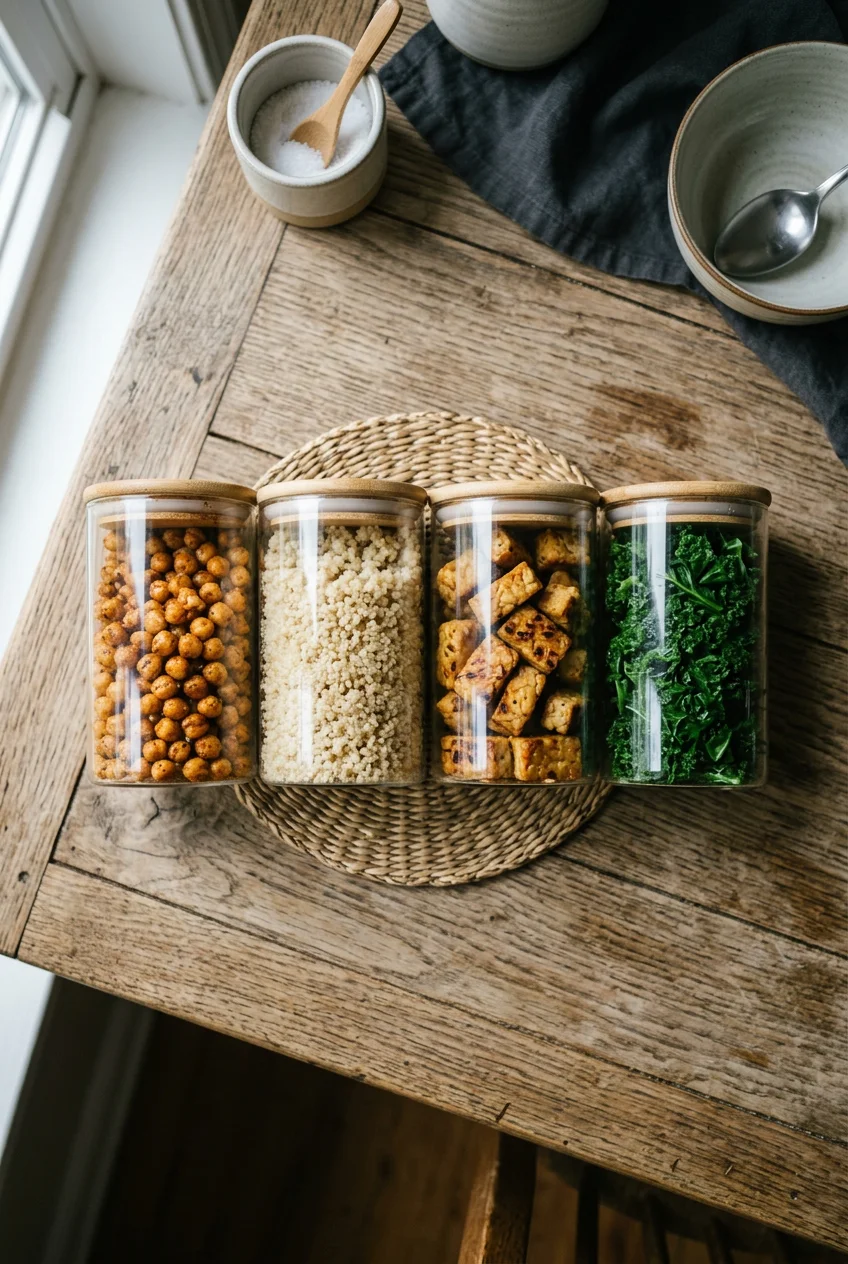
What’s Inside
- Master the Vacuum-Sealed Tofu Scramble
- Chickpea Pasta Bakes for Heavy Rotation
- Savory Whole Milk Cottage Cheese Bowls
- Edamame and Quinoa Mason Jars
- Tempeh Crumbles for Taco Salads
- High-Yield Lentil Stews for Freezing
- Greek Yogurt Chicken-less Salad
- Seitan Strips for Quick Stir-Fries
- Hemp Seed and Chia Overnight Oats
Last Tuesday at Whole Foods, I dropped a full 32 oz container of plain Greek yogurt directly onto my suede boots. It exploded outward in a thick white radius, coating my pants and the grocery store floor. That embarrassing cleanup was my rock bottom for trying to figure out vegetarian meal prep high protein routines without a solid grocery plan. I was just wandering the aisles, grabbing random tubs of dairy, and hoping my macros would magically align. Nailing down a vegetarian meal prep high protein menu requires actual math and specific ingredients. Otherwise, you’re just eating 60 grams of pasta carbs per meal and feeling hungry an hour later.
Skip the fat-free dairy and generic water-packed tofu blocks. The fat-free stuff tastes like wet cardboard, and standard tofu requires too much prep work for a busy Sunday afternoon. I’m going to walk you through exactly what I prep now. I’ve eaten these meals for the last two years, tweaking the ingredient ratios until the protein counts actually hit 25 to 30 grams per serving. You don’t need to spend six hours in the kitchen to hit your protein goals without meat. You just need better ingredients, exact measurements, and a methodical approach to storing your food.
1. Master the Vacuum-Sealed Tofu Scramble

Trader Joe’s High Protein Organic Tofu ($2.99 for a 16 oz vacuum-sealed pack) is the only tofu I buy for morning scrambles. Regular water-packed tofu requires pressing, which is a massive waste of time on a Sunday. Back in 2019, I tried pressing a block of extra firm tofu between two heavy dinner plates in my cramped apartment kitchen. The plates slipped, shattered on the tile floor, and left wet tofu mush everywhere. I’ve strictly purchased vacuum-sealed super firm tofu since that day. Trust me on this.
The Trader Joe’s version delivers 14 grams of protein per serving and has a dense, dry texture that crumbles perfectly into a hot cast iron skillet. A common mistake people make is using silken tofu for scrambles. It turns into a watery, unappetizing soup in the pan. For my weekly batch, I crumble two full blocks into a large skillet with 1 tablespoon of olive oil. I mix in 1/4 cup of nutritional yeast, 1 teaspoon of ground turmeric for that bright yellow color, and 1/2 teaspoon of black salt (kala namak).
The black salt provides a distinct sulfur smell and taste that mimics actual eggs. I cook this over medium heat for about eight minutes until the edges get slightly crispy. I divide the scramble into four glass Pyrex containers ($22.99 for a set of three at Target) and store them in the fridge. They reheat in the microwave in exactly 90 seconds. You’re getting around 28 grams of protein per container, and it stays perfectly fresh from Monday through Thursday.
2. Chickpea Pasta Bakes for Heavy Rotation

Target sells Banza Penne for $3.19 per 8 oz box. It provides 11 grams of protein per 2 oz serving, making it a highly efficient base for a vegetarian meal prep high protein dinner. The gritty texture of early lentil and chickpea pastas used to ruin my meals, but Banza holds up well if you follow one specific rule: undercook it by exactly two minutes. If the box says boil for 9 minutes, I pull it at 7.
I learned that the hard way after baking fully cooked chickpea pasta. It turned into a mushy, starchy paste that stuck to the roof of my mouth. By undercooking the pasta before baking, it absorbs the sauce in the oven without losing its structural integrity. For my prep, I boil two boxes of Banza penne for 7 minutes, drain, and mix it in a large bowl.
I add 1 cup of whole milk ricotta (Galbani, $4.99 for 15 oz at Kroger), 1/2 cup of shredded mozzarella, and 2 cups of Rao’s Marinara ($7.99 for a 24 oz jar). I spread this mixture into a 9×13 glass baking dish, top with another 1/2 cup of mozzarella, and bake at 375 degrees for 20 minutes. Once it cools, I slice it into six portions. Each square packs roughly 22 grams of protein. I wrap the individual squares in aluminum foil and freeze three of them, keeping the other three in the fridge for immediate weeknight dinners.
3. Savory Whole Milk Cottage Cheese Bowls

Good Culture 4% Whole Milk Classic Cottage Cheese ($4.99 for 16 oz at Sprouts) completely altered my breakfast routine. It contains 14 grams of protein per half-cup serving. For years, I tried forcing myself to eat sweet cottage cheese with pineapple or strawberries. Last summer, I took a bite of a warm pineapple cottage cheese bowl and actually gagged at the sour, clashing flavors. The texture of dairy curds simply doesn’t pair well with acidic fruit for my palate.
Switching to savory toppings fixed the issue entirely. The salty, creamy texture of whole milk cottage cheese pairs perfectly with crunchy vegetables and spices. A pro tip: skip the low-fat or fat-free versions. The 4% milkfat prevents the watery separation that happens in the fridge by Wednesday. You might also like: 10 Dinner Meal Prep for Every Budget
For a four-day prep, I line up four small glass mason jars. Into each jar, I measure exactly 3/4 cup of cottage cheese. I top it with 1/4 cup of halved cherry tomatoes, 1 tablespoon of Everything But The Bagel seasoning ($1.99 at Trader Joe’s), and 1 teaspoon of chili crisp (Lao Gan Ma, $3.99 for 7.4 oz). The chili crisp adds a deep, savory heat and a crunchy texture from the fried soybeans. I screw the lids on tight. These jars sit in the fridge and take zero effort to grab on my way out the door. You’re securing 21 grams of protein before 9 AM. You might also like: 15 Inspiring Chicken Meal Prep Ideas You Haven’t Thought Of

Bento Box Adult Lunch Box – 4 Pack, 5
Honestly, Bento Box Adult Lunch Box – 4 Pack surprised me — sturdier than it looks in the photos, and over 24 buyers gave it 4.5 stars.
4. Edamame and Quinoa Mason Jars

Seapoint Farms Shelled Edamame ($2.49 for a 12 oz bag at Walmart) is a staple for vegetarian meal prep high protein lunches. Edamame yields 17 grams of protein per half-cup serving, which is exceptionally high for a green vegetable. Combining it with quinoa creates a dense, filling meal that doesn’t require reheating in a dirty office microwave. You might also like: 10 Healthy Breakfast Meal Prep That Actually Work
The most common mistake with mason jar salads is the layering order. I used to put my dressing on top of the quinoa. By Tuesday, the quinoa would absorb all the liquid and smell strongly like a wet dog. The texture was completely ruined. You have to put the dressing at the very bottom of the jar, followed by hearty vegetables that won’t absorb liquid, and put the grains at the top.
I line up five 32 oz wide-mouth mason jars. At the bottom of each, I pour 2 tablespoons of sesame ginger dressing. Next, I add 1/4 cup of shredded carrots, forming a barrier. Then comes 1/2 cup of thawed shelled edamame. Finally, I pack 1/2 cup of cooked, completely cooled quinoa on top. I seal the jars and leave them in the fridge. When it’s time to eat, I shake the jar vigorously for ten seconds to distribute the dressing. Pour it into a bowl, and you have a crunchy, cold salad with roughly 22 grams of protein.
5. Tempeh Crumbles for Taco Salads

Lightlife Original Tempeh ($3.49 for 8 oz at Whole Foods) is incredibly dense, offering 18 grams of protein per 3 oz serving. Tempeh is fermented soy, and straight out of the package, it has a bitter, earthy taste that ruins a lot of recipes. Early in my meal prep days, I just crumbled raw tempeh into a pan and fried it. It tasted like sour dirt, and I ended up throwing away four days’ worth of lunches.
The necessary step is boiling the tempeh first. I unwrap two 8 oz blocks, cut them in half, and simmer them in a pot of water for 10 minutes. This draws out the bitterness and softens the dense cake, making it much easier to crumble and eager to absorb marinades. After boiling, I pat the tempeh dry with paper towels.
I heat 1 tablespoon of olive oil in a skillet and crumble the boiled tempeh into the pan using my hands. I add 2 tablespoons of low sodium soy sauce, 1 teaspoon of ground cumin, 1/2 teaspoon of smoked paprika, and 1/4 cup of water. I let this simmer until the liquid evaporates, leaving behind heavily spiced, savory crumbles that mimic taco meat. I store the crumbles in a large Tupperware container. Throughout the week, I measure out a half-cup of crumbles over chopped romaine lettuce and black beans for a massive protein boost.
6. High-Yield Lentil Stews for Freezing

I buy small brown lentils from the bulk bins at Sprouts for about $1.99 per pound. Half a cup of cooked lentils provides 9 grams of protein. Lentils are cheap, but they require proper seasoning, or they taste incredibly bland. I spent months making watery lentil soups that lacked depth before realizing I needed to aggressively season the broth and add acid at the end of the cooking process.
The earthy smell of simmering lentils is fantastic on a Sunday afternoon. For a large batch, I rinse 2 cups of dry brown lentils in a mesh strainer. In a large Dutch oven, I sauté 1 cup of diced carrots and 1 cup of diced celery in olive oil until soft. I add the lentils and pour in 6 cups of vegetable broth (Pacific Foods, $3.99 for 32 oz). I bring it to a boil, drop the heat to low, and let it simmer uncovered for 30 minutes until the lentils are tender and the stew is thick.
The pro tip here is stirring in 2 tablespoons of fresh lemon juice right after you turn off the heat. The acid cuts through the heavy, starchy texture of the lentils and brightens the entire pot. I ladle the stew into Souper Cubes ($29.99 on Amazon)—which are essentially giant silicone ice cube trays—and freeze them. Once frozen solid, I pop the blocks out and store them in a freezer bag. You just drop a block into a mug and microwave it for four minutes when you’re ready to eat.

Food Scale, 11lb Digital Kitchen Scale with 6 Units LCD
Food Scale punches above its price — 21 buyers rated it 4.5 stars. I would buy it again.
7. Greek Yogurt Chicken-less Salad

Fage Total 5% Greek Yogurt ($6.99 for 32 oz at Costco) serves as a high-protein replacement for mayonnaise in traditional salad recipes. It yields 15 grams of protein per 3/4 cup. Using fat-free yogurt is a massive mistake here. I tried it once, and the water content separated from the solids, leaving my chickpea salad sitting in a puddle of cloudy whey by Wednesday. The 5% milkfat creates a thick, creamy binder that holds up for days.
I drain and rinse two 15 oz cans of chickpeas ($0.89 each at Kroger). I dump them into a large mixing bowl and use a potato masher to crush them until flaky. You don’t want a paste; you want texture. I fold in 2/3 cup of the 5% Greek yogurt, 2 tablespoons of Dijon mustard, 1/2 cup of finely diced red onion, and 1/2 cup of chopped dill pickles.
The mixture smells tangy and savory. The crunch of the pickles balances the creamy, mashed chickpeas perfectly. I divide this mixture into four small containers. I pair each container with a handful of Mary’s Gone Crackers ($4.99 at Whole Foods) packed in a separate dry bag. The crackers add another 5 grams of plant protein. The chickpea salad itself gives you about 18 grams of protein per serving, making it a cold, refreshing lunch option that requires zero reheating.
8. Seitan Strips for Quick Stir-Fries

Franklin Farms Seitan Strips ($4.99 for 8 oz at Whole Foods) provide an incredible 21 grams of protein per 2.5 oz serving. Seitan is vital wheat gluten, and it has a chewy, dense texture that mimics chicken strips better than tofu or tempeh. However, if you overcook seitan, it rapidly turns into the texture of a rubber tire. I ruined an entire wok full of vegetables last year by letting the seitan simmer in the sauce for twenty minutes. It became completely unchewable. No exaggeration.
Seitan is already cooked when you buy it. You only need to heat it through and glaze it with sauce. I start by chopping 4 cups of fresh broccoli florets. I heat 1 tablespoon of toasted sesame oil in a large wok over high heat. I toss in the broccoli and 1/4 cup of water, covering the wok immediately to let the steam soften the broccoli for exactly three minutes.
I remove the lid, let the water evaporate, and toss in two packages of the seitan strips. I pour in 1/4 cup of teriyaki sauce (Soy Vay, $4.49 for 21 oz at Target). I stir constantly for exactly two minutes—just long enough for the sauce to bubble, thicken, and coat the strips. I pull it off the heat immediately. I portion this out into four containers alongside a half-cup of brown rice. The seitan remains tender, and the broccoli stays crisp. It’s an easy 30-gram protein dinner.
9. Hemp Seed and Chia Overnight Oats

Manitoba Harvest Hemp Hearts ($7.99 for 8 oz at Target) are the secret to boosting the protein content of standard overnight oats. They offer 10 grams of protein per 3 tablespoons. When combined with soy milk, which naturally has more protein than almond or oat milk, you can build a breakfast with over 20 grams of protein without relying on chalky protein powders.
I used to dump cheap vanilla whey powder into my overnight oats. It resulted in a grainy, artificial-tasting sludge that I dreaded eating. Relying on whole seeds instead completely fixes the texture issue. The chia seeds create a thick, gelatinous pudding, while the hemp hearts add a soft, nutty bite.
On Sunday night, I line up four jars on my counter. Into each jar, I pour 1/2 cup of rolled oats (Quaker, $4.29 for 18 oz). I add 1 cup of unsweetened soy milk (Silk Original, $3.99 for 64 oz, which adds 8 grams of protein). I stir in 2 tablespoons of chia seeds and 2 tablespoons of hemp hearts. I add a dash of cinnamon and clamp the lids down. I give each jar a hard shake and place them in the fridge. By morning, the oats have absorbed the soy milk, and the seeds have expanded. I eat it cold straight from the jar. It’s dense, filling, and keeps me full well past noon.
Figuring out a reliable vegetarian meal prep high protein routine took me a lot of trial and error, a few broken plates, and some genuinely terrible lunches. But once you lock in the measurements and find the exact brands that work for you, the process becomes entirely mechanical. I highly recommend starting with the chickpea pasta bake and the tofu scramble, as they yield the most food for the least amount of active cooking time. Pin this list for your next Sunday prep session so you aren’t wandering the aisles at Whole Foods guessing at macros.

buluker 4 Pack Bento Lunch Box Set 3 Compartment Food
If you want something that just works, buluker 4 Pack Bento Lunch Box Set 3 Compartment Food Storage Containe is a safe bet (23 reviews, 4.5 stars).
Frequently Asked Questions
How do I ensure my vegetarian meal prep high protein stays fresh all week?
Store your meals in airtight glass containers like Pyrex. Keep wet ingredients separate from dry ones, and always place dressings at the bottom of mason jars to prevent soggy grains.
What is the best high protein pasta for meal prep?
Banza chickpea pasta is highly effective, offering 11 grams of protein per 2 oz serving. Undercook it by two minutes before baking or storing to maintain a firm texture.
Can I freeze tofu scrambles for meal prep?
Yes, tofu scrambles freeze well. Use vacuum-sealed super firm tofu to avoid excess moisture. Freeze in airtight containers and microwave for 90 seconds to reheat.
How do I make tempeh taste better for meal prep?
Boil the raw tempeh block in water for 10 minutes before marinating or frying. This removes the natural bitterness and softens the dense texture, allowing it to absorb flavors.
