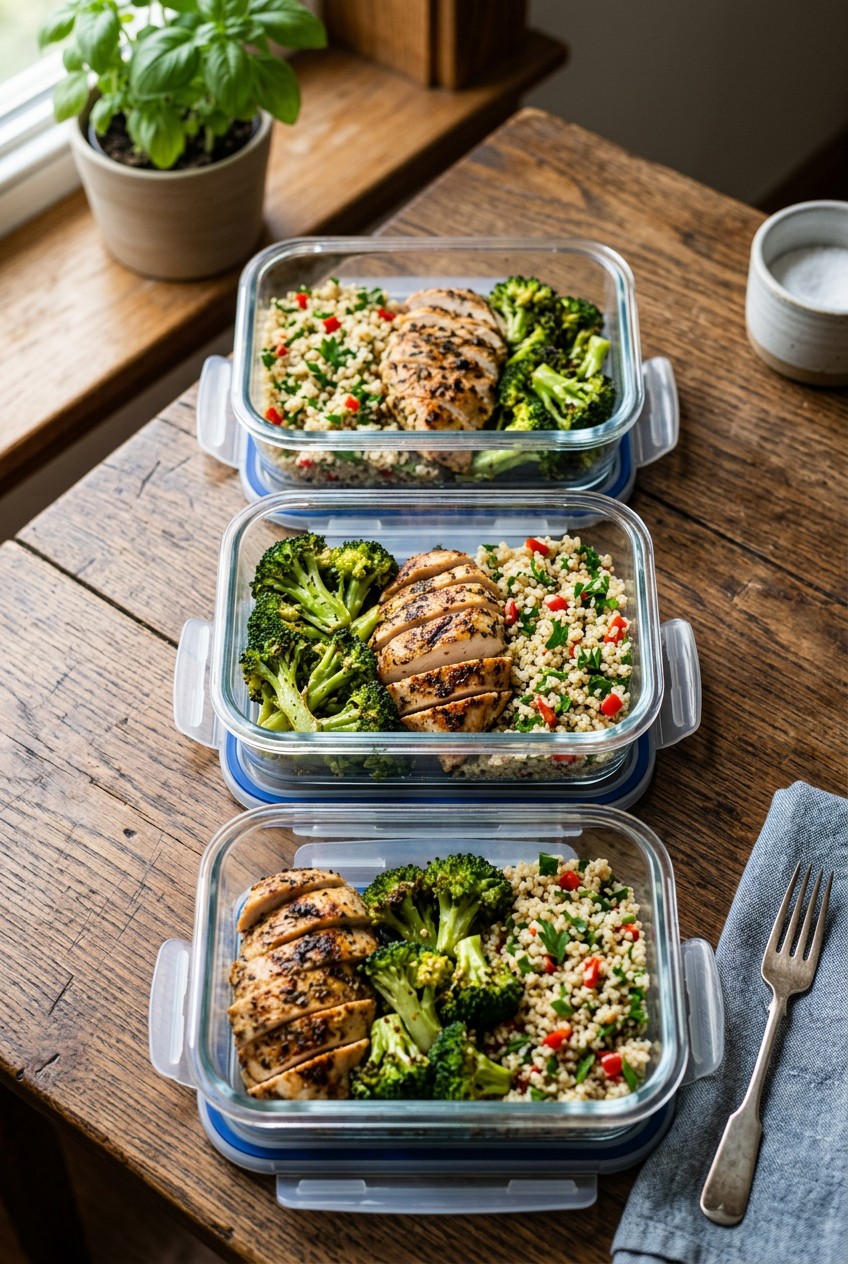
What’s Inside
- 1. Master the Brine for Juicy Protein Meal Prep
- 2. Stop Overpaying and Use Budget Protein Sources
- 3. Switch to Ingredient Prep Instead of Full Meals
- 4. Upgrade Your Containers to Prevent Leaks
- 5. Sneak in Extra Macros with High-Protein Pasta
- 6. Master the Art of Prepping and Reheating Fish
- 7. Keep Emergency Pre-Cooked Proteins on Hand
- 8. Weigh Your Food to Stop Guessing Portions
Last Tuesday I stood in the middle of Whole Foods staring at a $14 pre-packaged salad and wanted to cry. The lettuce was already turning slimy at the edges. The chicken chunks looked like gray rubber erasers. I realized right then that my approach to protein meal prep was completely broken. I’m Esperanza Eliza. I’ve spent years forcing down dry chicken breasts on busy weeknights just to hit my macro goals. I tried doing the whole Sunday prep thing wrong for months before figuring it out. I’d cook seven identical meals in cheap plastic tubs. By Wednesday, the smell of stale broccoli made me physically nauseous. I ended up throwing away half of it every single week. It’s frustrating to waste money and time when you’re just trying to be healthy. Now I do things differently. I focus on real ingredients, actual flavor, and methods that fit into a chaotic schedule. I skip the fat-free stuff entirely. It tastes like wet cardboard and leaves you starving an hour later. You’re going to need a better plan if you want to stick to eating healthy when you’re exhausted after a nine-hour shift. I’m going to show you exactly how I handle my week. You won’t find any complicated chef tricks here. Just real food for real life. Let’s fix your fridge.
1. Master the Brine for Juicy Protein Meal Prep

Most people get this wrong right out of the gate. They throw raw chicken breasts on a baking sheet, sprinkle some pepper, and hope for the best. I used to do this, too. I’d end up chewing on chicken that felt like literal sawdust. My jaw actually hurt. Then I learned about brining. It’s incredibly simple. You just soak your meat in salted water. I dissolve 1/4 cup of Morton Kosher Salt ($3.49 for a 3 lb box at Target) into 4 cups of warm water in a large glass bowl. Then I add 4 cups of ice water to cool it down. I submerge 3.5 lbs of Kirkland Signature chicken breasts in this ice bath for exactly 30 minutes. Don’t leave it longer or it gets a weird, mushy texture. I learned that the hard way last month when I got distracted by a phone call. The chicken turned into a spongy mess. After 30 minutes, pull the chicken out and pat it completely dry with paper towels. You want the surface bone-dry so it roasts instead of steams. I season it heavily with smoked paprika and garlic powder. Then I bake it at 400°F for 22 to 25 minutes. Aim for an internal temperature of 165°F. This batch yields about five solid portions. Each 6 oz serving gives you roughly 35g of protein. The difference in texture is insane. When you cut into it, the juices actually pool on the cutting board. It stays moist in the fridge for days. You won’t ever want to skip this step. It fixes the dry chicken problem that ruins most diets.
2. Stop Overpaying and Use Budget Protein Sources

I used to spend half my paycheck on fancy grass-fed steaks and artisanal turkey patties. My grocery bill at Sprouts was embarrassing. I’m talking $180 just for myself for one week. I couldn’t sustain it. You don’t need to buy the most expensive cuts to hit your macros. I shifted my focus to budget-friendly protein powerhouses. It changed everything. Now I buy dried lentils in bulk. A 1 lb bag of Goya Brown Lentils costs about $1.99 at Walmart. That’s around $0.15 per serving. I boil 1 cup of dry lentils in 3 cups of chicken broth until tender. They get this earthy, rich flavor and a perfectly chewy texture that holds up all week. I also rely heavily on eggs. A dozen Pete and Gerry’s Organic Eggs is roughly $5.99 at Kroger. That’s about $0.50 per egg, but if you buy the store brand, it’s closer to $0.25. I hard-boil a batch of six on Sunday mornings. The smell isn’t glamorous, but the convenience is unbeatable. Canned tuna is another massive staple. I stock up on StarKist Chunk Light Tuna in Water. It’s usually $1.14 for a 5 oz can at Target, making it about $0.75 per serving. I mix it with a little avocado mayonnaise, diced celery, and black pepper. Finally, swap your chicken breasts for thighs sometimes. A pack of Foster Farms boneless skinless chicken thighs runs about $1.00 per serving at Costco. They’ve got more fat, which means more flavor and a much softer bite. Mixing these cheap sources into your routine saves a massive amount of cash without sacrificing your goals.
3. Switch to Ingredient Prep Instead of Full Meals

I’ve got a confession. I hate eating the exact same meal four days in a row. By Thursday, looking at another identical black plastic container of chicken and rice makes me want to order a massive pizza. I tried the traditional prep method for a year. I’d assemble 15 identical containers on Sunday. By Wednesday, the rice was hard as a rock and the broccoli smelled like sulfur. I ended up scraping so much food straight into the trash. Now I do ingredient prep. This is the best way to handle weeknights in 2026. I cook my proteins, grains, and vegetables separately. I store them in large glass bowls in the fridge. On Monday night, I might take 4 oz of my cooked chicken, 1/2 cup of Lundberg Family Farms Jasmine Rice ($7.49 for a 2 lb bag at Whole Foods), and a handful of roasted bell peppers. I toss them in a hot cast iron pan with a spicy peanut sauce. On Tuesday, I’ll take that same chicken and throw it over crisp romaine lettuce with some Ken’s Steak House Caesar Dressing ($3.49 for 16 oz at Walmart). You avoid flavor fatigue completely. You’re just mixing and matching components based on what you crave. It takes five minutes to assemble a fresh plate. The textures stay much better this way, too. The rice doesn’t soak up the vegetable juices and turn to mush. I keep three different sauces in the fridge at all times. A good teriyaki, a Greek vinaigrette, and a sugar-free BBQ sauce. This variety keeps my tastebuds happy. You might also like: 15 Inspiring Chicken Meal Prep Ideas You Haven’t Thought Of

VERONES 10 Pack 22 OZ Glass Meal Prep Containers
Honestly, VERONES 10 Pack 22 OZ Glass Meal Prep Containers surprised me — sturdier than it looks in the photos, and over 18 buyers gave it 4.5 stars.
4. Upgrade Your Containers to Prevent Leaks
Let me tell you about the great soup disaster of 2024. I was carrying my lunch bag onto the crowded subway. I’d packed a beautiful, protein-packed turkey chili in a flimsy plastic takeout container. Somebody bumped into me hard. The lid popped right off. I spent the next twenty minutes smelling like cumin and tomatoes while wiping cold chili off my favorite shoes. It was humiliating. I threw away all my cheap plastic containers that night. You’ve got to invest in quality, leak-proof storage. I swear by Rubbermaid Brilliance containers. You can get a 10-piece set for about $29.99 at Target. They’re crystal clear and snap shut with a satisfying click. The rubber gasket actually seals tight. I can hold them upside down and shake them. Nothing comes out. If you prefer glass, the Prep Naturals Glass Containers are fantastic. A 5-pack runs under $25 on Amazon. They’re heavy, cold to the touch, and don’t absorb weird garlic smells. If you struggle with portion control, look into divided containers. I use the Bentgo Prep 3-Compartment containers. A 10-pack is typically $22.99 at Target. The dividers keep my wet roasted tomatoes away from my crispy proteins. The macros stay balanced without me having to think about it. Plus, when you reheat food in the microwave, you need to vent it. The Rubbermaid ones have latches you can pop open to let steam escape. This prevents your food from getting soggy and sad. Good containers are worth every penny. You might also like: 20 Inspiring Meal Prep Ideas for Any Style
5. Sneak in Extra Macros with High-Protein Pasta

I love pasta. I refuse to give it up. I tried zucchini noodles for a while to save carbs. Let’s be honest. They taste like watery string. They leave a gross puddle of green liquid at the bottom of your bowl. I was always starving an hour later. Then I discovered high-protein pasta. It fixed my pasta cravings while keeping my macros in check. My favorite is Barilla Protein+ Penne. It’s roughly $2.99 for a 14.5 oz box at Kroger. It gives you 10g of protein per 2 oz serving. It tastes exactly like regular wheat pasta. It has that firm, starchy bite that holds onto sauces beautifully. If you want a gluten-free option, Banza Chickpea Pasta is incredible. It packs 11g of protein per serving. An 8 oz box is about $3.99 at Target. It has a slightly nuttier flavor and a denser texture. You’ve got to rinse the Banza immediately with cold water after boiling, or it gets gummy. I learned that the hard way. I ruined a whole batch of mac and cheese because it turned into a giant, sticky orange brick. I like to pair these pastas with a simple meat sauce. I’ll brown 1 lb of 93% lean ground turkey and mix it with Rao’s Homemade Marinara ($7.99 for 24 oz at Whole Foods). If you want a plant-based complete protein, you can mix legumes and grains. I make a killer bowl with 1/2 cup of cooked quinoa and 1/2 cup of chickpeas. It provides an amazing 32g of protein. It’s chewy, hearty, and filling for those long workdays. You might also like: 20 Beautiful High Protein Meal Prep Ideas That Are Totally Worth It
6. Master the Art of Prepping and Reheating Fish

People aren’t usually comfortable meal prepping fish. I get it. Nobody wants to be the person stinking up the office microwave on a Tuesday. I avoided it for years. But fish is too good for you to skip. You just have to know how to handle it. I buy the Kirkland Signature Frozen Atlantic Salmon portions from Costco. A 3 lb bag is about $34.99. I thaw two 6 oz fillets overnight in the fridge. I bake them on a sheet pan at 375°F for 14 to 16 minutes. Here’s the secret. You’ve got to slightly undercook it. When you pull it out, the center should still be a tiny bit translucent and dark pink. It’ll finish cooking when you reheat it. If you cook it all the way through initially, it turns into dry, chalky flakes later. For white fish like cod or tilapia, moisture is your enemy when reheating. I take a piece of Bounty paper towel, run it under the sink, and wring it out completely. I drape this damp towel over my glass container before microwaving. It traps the steam and keeps the fish flaky and soft. You’ve also got to respect food safety. Cooked fish is only safe in the refrigerator for 3 to 4 days max. I never push this. The smell changes from ocean-fresh to sour by day five. Plant proteins like tofu can last a week, but seafood is delicate. Eat your fish meals on Monday and Tuesday. Save your chicken and lentils for Thursday and Friday.

HOMBERKING 10 Pack Borosilicate Glass Meal Prep Containers
A dependable everyday pick — HOMBERKING 10 Pack Borosilicate Glass Meal Prep Containers with Lockin pulls in 23 ratings at 4.5 stars. Not flashy, just solid.
7. Keep Emergency Pre-Cooked Proteins on Hand
We’ve all got those weeks. You plan to spend Sunday afternoon chopping vegetables and roasting meats. Instead, your car breaks down, your kids get sick, or you just desperately need a nap. Last month, I spent my entire Sunday dealing with a flooded washing machine. By 6 PM, my kitchen was a disaster zone. The last thing I wanted to do was touch raw chicken or wash cutting boards. This is why you’ve got to keep emergency pre-cooked proteins on hand. I always keep a bag of Perdue Short Cuts Carved Chicken Breast. A 9 oz package is about $4.99 at Walmart. It’s fully cooked and has a great grilled flavor. I just tear open the bag and dump it over some mixed greens. I also love the John Soules Foods Grilled Chicken Strips. A 16 oz bag runs around $7.49 at Target. They’re slightly salty with visible grill marks. They save me from ordering a $25 delivery pizza when I’m exhausted. You shouldn’t forget about protein-rich snacks, either. I try to spread my intake across five or six smaller meals daily. I aim for 10 to 20g of protein per snack. My go-to is Good Culture Low Fat Cottage Cheese. A 5.3 oz cup is $1.69 at Whole Foods. It’s thick, creamy, and doesn’t get that watery separation cheap brands have. I also keep hard-boiled eggs ready. Having these grab-and-go options stops me from eating an entire bag of tortilla chips while staring blankly into the pantry at 4 PM.
8. Weigh Your Food to Stop Guessing Portions

I used to eyeball all my portions. I’d grab what looked like a 4 oz piece of chicken and log it. I was dead wrong. Visual estimation of meat is notoriously inaccurate. I was actually eating closer to 7 oz of chicken per meal. I was constantly feeling stuffed, and my grocery budget was bleeding dry. You absolutely need a digital food scale if you want your protein meal prep to work. I bought the OXO Good Grips 11 lb Food Scale. It costs $55.99 at Target. It has a brilliant pull-out display so you can read the numbers even when you’ve got a giant bowl on top. I place my empty Rubbermaid container on the scale, hit the tare button, and add exactly 6 oz of cooked meat. It takes ten extra seconds. It gives me complete control over my macros. When it comes time to eat, reheating safely is crucial. I always use a digital meat thermometer to check my reheated meals. You need to hit an internal temperature of 165°F to ensure food safety. I use a ThermoPro Digital Thermometer ($14.99 on Amazon). I poke it right into the thickest piece of chicken. If it’s only at 120°F, it goes back in the microwave for another thirty seconds. Eating lukewarm, rubbery chicken is a miserable experience. Taking the time to measure your portions and heat them properly makes the whole process feel less like a chore and more like a high-end habit. It changes how you experience your weekday lunches.
I know getting started can feel overwhelming. I promise you don’t have to do it all at once. Start by just brining your chicken this weekend. See how much better it tastes. Then maybe buy a food scale next payday. Building a sustainable routine is about making small, permanent changes. I’ve wasted so much time and money doing things the hard way. I want you to avoid all those frustrating mistakes. If you actually enjoy the food you pack, you won’t be tempted by the drive-thru on your way home. You’ll feel better, your wallet will be heavier, and your weeknights will be peaceful. Please pin this article to your favorite recipe board on Pinterest so you can find these exact temperatures and measurements next Sunday. Share it with a friend who hates dry chicken as much as we do. You’ve got this. Let’s make this week delicious.
Frequently Asked Questions
How long does meal-prepped chicken last in the fridge?
Cooked poultry is generally safe in the refrigerator for 3 to 4 days. Always store it in an airtight container to maintain moisture and prevent spoilage.
Can I meal prep fish without it drying out?
Yes. Bake salmon at 375°F for 14 to 16 minutes, leaving it slightly undercooked. When reheating, drape a damp paper towel over your container to trap steam and keep the fish flaky.
What are the cheapest high-protein foods to prep?
Dried lentils, eggs, canned tuna, and chicken thighs are incredibly budget-friendly. Lentils cost around $0.15 per serving, making them a fantastic plant-based staple for weekly prep.
How do I avoid getting bored with my meal prep?
Switch to ingredient prep. Cook your proteins, grains, and vegetables separately. Store them in glass bowls and mix them with different sauces each night to completely eliminate flavor fatigue.