What’s Inside
- Master the 50/25/25 Rule for Healthy Recipes Meal Prep
- Upgrade Your Storage Containers Immediately
- Sous Vide Chicken Breasts for Consistent Protein
- Ground Turkey and Quinoa Macro Bowls
- High-Protein Lentil Pasta Salads
- Roasted Tempeh and Sweet Potato Cubes
- Greek Yogurt Chicken Salad for Cold Lunches
- Sheet Pan Salmon and Asparagus
- Cottage Cheese and Egg White Frittata Slices
- Tofu Scramble for Plant-Based Healthy Recipes Meal Prep
- Freezable Black Bean and Beef Burritos
Last Tuesday at Whole Foods, I watched a bruised rotisserie chicken leak brown grease all over my canvas tote bag while I was standing in the checkout line. The cashier handed me a wad of thin brown paper towels, but the damage was done. That was the exact moment I realized my approach to healthy recipes meal prep was fundamentally broken. I was grabbing random proteins at the last minute, tossing them in cheap plastic tubs, and hoping for the best. It usually resulted in sad, soggy lunches by Wednesday that smelled vaguely of old garlic. You can’t just wing it when you’re trying to hit protein goals and eat clean. You need a methodical system. I’m Esperanza, and I write for simpleprepsunday.com because I got tired of eating dry, rubbery chicken breasts at my office desk. Let’s talk about how to actually prep food that tastes good four days later. The trick isn’t making complicated gourmet meals that take six hours on a Sunday. The trick is understanding how moisture, temperature, and storage containers affect food over time. I’ve ruined enough quinoa and wilted enough spinach to know exactly what fails in the refrigerator. Here is my highly specific, analytical breakdown of high-protein meals that actually survive the week.
1. Master the 50/25/25 Rule for Healthy Recipes Meal Prep

Nutrition experts talk about balanced plates constantly, but translating that abstract concept to a physical glass container requires actual math. I use the 50/25/25 rule for my healthy recipes meal prep. You allocate 50 percent of the container to vegetables, 25 percent to lean protein, and 25 percent to complex carbohydrates. I tried doing 50 percent brown rice for months before figuring this out. I’d eat a massive bowl of rice and chicken, and by 2:00 PM, I was asleep at my keyboard. The carbohydrate crash is real and completely avoidable. Now, a standard box for me looks exactly like this: 2 cups of mixed leafy greens (I buy the Kroger Private Selection spring mix for $3.49), a 4 oz portion of grilled protein, and exactly 1/2 cup of cooked starch. The 1/2 cup measurement is critical. I use a literal measuring cup when packing the boxes on Sunday. It looks small in the container, but the 2 cups of greens provide the physical volume your stomach needs to feel full without the heavy starch crash. The 4 oz of protein keeps your blood sugar stable. If you’re skipping the greens because they wilt in the fridge, you’re doing it wrong. Pack them bone dry, place a folded paper towel at the bottom of the container to absorb ambient moisture, and keep a $2.99 bottle of Newman’s Own dressing at your office desk.
2. Upgrade Your Storage Containers Immediately

Skip the cheap plastic tubs. I bought a 50-pack of flimsy plastic containers on Amazon two years ago because they were cheap. After one week of storing turmeric chicken, they were permanently stained yellow and smelled vaguely of curry for the rest of their short lives. Plastic absorbs odors, warps in the dishwasher, and eventually cracks at the corners. You need heavy-duty glass. I recommend the OXO Smart Seal Glass Container Sets. They usually run about $29.99 for a set at Target. The silicone seal actually comes out so you can clean the black mold that inevitably tries to grow in the crevices. The lid latches one-handed, which matters when I’m holding a bag of groceries in the other hand. If you need a larger batch for bulk prep, the Glasslock 18-Piece Glass Food Storage Set is around $39.99 at Costco. Glass containers are heavy. That is the physical tradeoff you have to accept. My work bag weighs ten pounds on Mondays when I carry all my food in. But glass won’t absorb food odors, and you can safely microwave it without wondering if you’re eating leached microplastics. If you absolutely require plastic for budget or weight reasons, the Bentgo Prep 10-Pack Meal Prep Containers are $14.99 at Walmart. They aren’t perfect, but they stack neatly in a narrow fridge.
3. Sous Vide Chicken Breasts for Consistent Protein

Most meal prep chicken is terrible. It’s rubbery on Monday and practically turns to chalk dust by Thursday. I fixed this by controlling the cooking temperature down to the exact degree. You need a sous vide immersion circulator. I use the Anova Culinary Sous Vide Precision Cooker Nano. It costs $129.00, and it completely removes human error from cooking poultry. You clip it to a pot of water, set it to 149 degrees Fahrenheit, drop in a vacuum-sealed bag of chicken, and wait 1.5 hours. I buy the Kirkland Signature organic chicken breasts at Costco ($14.99 for the pack). I season them heavily with 1 tsp of kosher salt and 1/2 tsp of coarse black pepper before sealing the bag. The result is chicken that retains its internal moisture perfectly because the water can’t evaporate. You can slice it cold on Wednesday and it still tastes juicy. A common mistake is searing the chicken for too long after taking it out of the water bath. If you sear it for more than 45 seconds per side in a hot cast iron pan, you cook the interior and ruin the entire sous vide process. Pat the meat completely dry with paper towels first. Moisture on the surface creates steam, which prevents a crust and overcooks the meat. Trust me on this.

Food Scale, 11lb Digital Kitchen Scale with 6 Units LCD
Food Scale has been one of the most consistently praised picks in this category. 21 reviewers averaged 4.5/5.
4. Ground Turkey and Quinoa Macro Bowls

Ground turkey is cheap and highly customizable, making it a staple for high-protein lunches. But you have to buy the right fat percentage. Skip the 99 percent fat-free turkey. It tastes exactly like wet cardboard and turns into tough little pebbles when you reheat it in an office microwave. I buy the Jennie-O 93/7 lean ground turkey. It’s $5.99 for a 16 oz package at Walmart. The 7 percent fat provides enough moisture to survive the reheating process. I brown the turkey in a wide skillet with 1 tbsp of olive oil, 1 tsp of cumin, and 1 tsp of smoked paprika. The caramel-butter smell of the spices blooming in the hot oil is fantastic and covers up that slightly gamey turkey scent. I pair 4 oz of the cooked turkey with 1/2 cup of tricolor quinoa. Quinoa has a slightly earthy, nutty texture that holds up significantly better than white rice in the fridge. I buy the Bob’s Red Mill organic quinoa for $6.49 at Sprouts. The trick to quinoa is rinsing it in a fine-mesh strainer under cold running water for a full minute before boiling. If you don’t rinse it, the natural saponins on the seeds make it taste bitter and soapy. You might also like: 15 Brilliant Salmon Dinner Ideas for Any Style
5. High-Protein Lentil Pasta Salads

Traditional wheat pasta makes me sleepy, so I rely on legume-based pastas for cold salads. Banza Chickpea Pasta is popular, but I prefer the Trader Joe’s Organic Yellow Lentil and Brown Rice Pasta. It’s $2.99 for a 12 oz bag. It yields about 14 grams of protein per 2 oz dry serving, which is excellent for a meatless lunch. Cooking alternative pastas requires strict precision. If you boil lentil pasta even one minute past the package instructions, it turns into a gummy paste that dissolves when you stir it. I set a timer and boil it for exactly 7 minutes, drain it, and immediately shock it with freezing cold water in the sink. This stops the cooking process instantly and rinses away the excess starch that causes clumping. I toss 1 cup of the cooked pasta with 2 cups of fresh baby spinach, 1 tbsp of extra virgin olive oil, 1/4 cup of halved cherry tomatoes, and 2 tbsp of Athenos crumbled feta cheese ($4.49 at Kroger). The acid from the tomatoes and the fat from the feta keep the pasta from sticking together in your container. Eat this one cold. Microwaving lentil pasta ruins the structural integrity completely. You might also like: 15 Inspiring Chicken Meal Prep Ideas You Haven’t Thought Of
6. Roasted Tempeh and Sweet Potato Cubes

You don’t need meat for every single meal. Tempeh is fermented soy, and it provides about 18 grams of protein per 3 oz serving. It has a firm, dense texture that doesn’t get mushy like tofu can. I buy the Lightlife Original Organic Tempeh for $3.49 at Sprouts. Straight out of the package, tempeh has a slightly bitter, mushroom-like flavor that turns people off. You have to steam it before you marinate it. I cut the block into 1-inch cubes and simmer them in a shallow pan of water for 10 minutes. This opens up the tempeh pores to absorb flavors. Then I marinate the cubes in 2 tbsp of Trader Joe’s Coconut Aminos ($4.99 a bottle), 1 tsp of sesame oil, and 1 tsp of garlic powder. I roast the tempeh on a sheet pan alongside 1 cup of diced sweet potatoes (tossed in 1 tbsp of avocado oil) at 400 degrees Fahrenheit for exactly 25 minutes. The sweet potatoes get crispy edges, and the tempeh turns savory and dark brown. I pack this with 1/2 cup of steamed broccoli. It’s a heavy, satisfying meal that reheats perfectly in exactly two minutes without losing its texture. You might also like: 10 Healthy Meal Prep Ideas for Every Budget

buluker 4 Pack Bento Lunch Box Set 3 Compartment Food
buluker 4 Pack Bento Lunch Box Set 3 Compartment Food Storage Containe has been one of the most consistently praised picks in this category. 23 reviewers averaged 4.5/5.
7. Greek Yogurt Chicken Salad for Cold Lunches

Mayonnaise-based chicken salads separate and look greasy after two days in the fridge. I substitute Greek yogurt to increase the protein content and stabilize the texture. You have to use the right yogurt. I bought a store-brand fat-free yogurt once, and by Wednesday, my chicken salad was swimming in a puddle of separated whey. It was disgusting and I threw it away. Learned that the hard way. Now I only use Fage Total 2% Milkfat Plain Greek Yogurt. It’s $6.49 for a 32 oz tub at Target. The 2 percent fat provides the necessary structural integrity so it doesn’t separate. I mix 1/2 cup of the yogurt with 3 cups of shredded cooked chicken breast, 1/4 cup of diced celery (Whole Foods 365 brand, $1.99 a bunch), 1/4 cup of halved red grapes, and 1/2 tsp of salt. The crunch of the fresh celery cuts through the dense yogurt and chicken mixture. I portion out 3/4 cup of the salad into my glass containers. I don’t pack bread. Bread gets soggy in the fridge environment. Instead, I pack 10 Simple Mills Almond Flour Crackers ($5.39 a box) in a separate Ziploc bag and scoop the chicken salad with them at my desk.
8. Sheet Pan Salmon and Asparagus

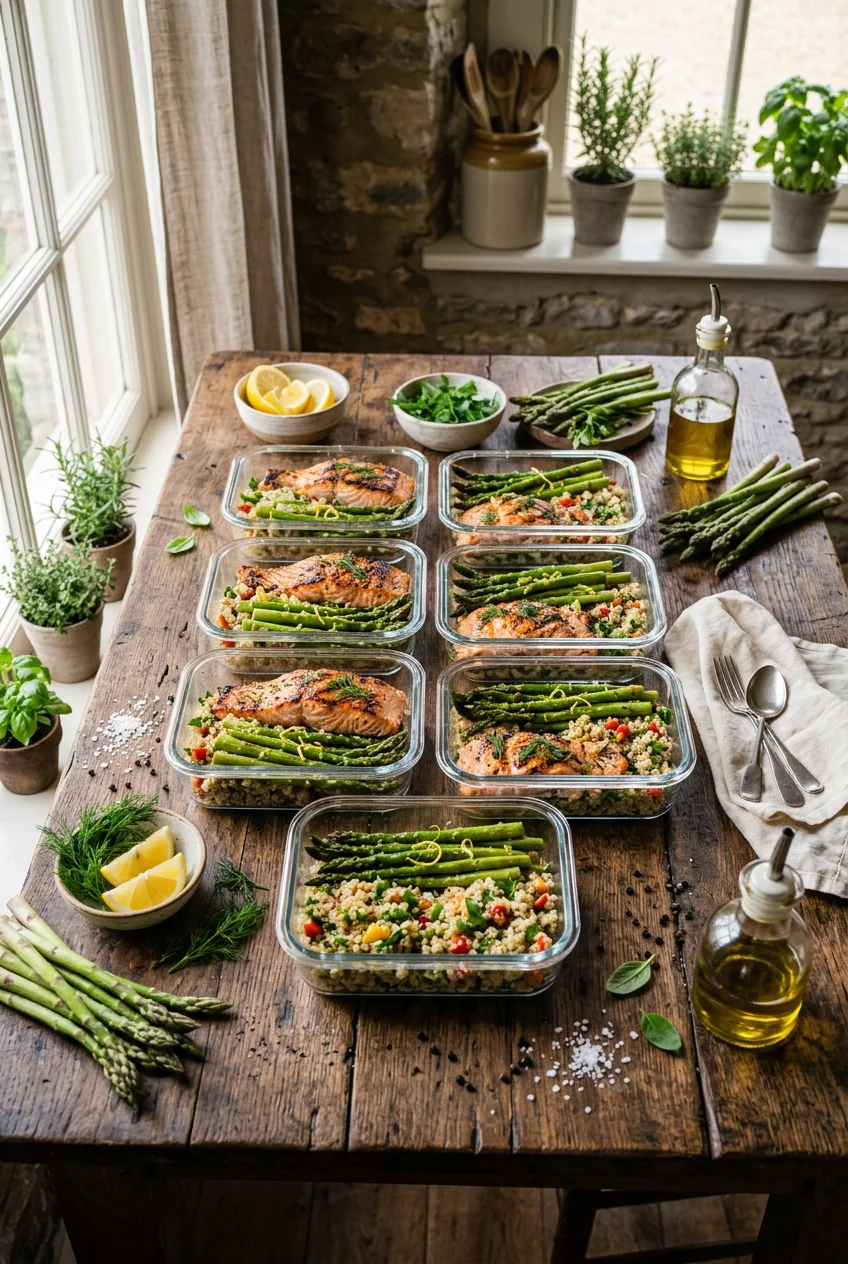
Seafood is notoriously tricky for meal prep, but salmon works if you handle it correctly. I buy the Kirkland Signature Farmed Atlantic Salmon at Costco. It’s usually around $32.99 for a massive package, which breaks down to a very reasonable price per ounce compared to buying individual fillets at a premium grocery store. I cut the large slab into 4 oz fillets. I place the fillets on a baking sheet lined with parchment paper, alongside 1 bunch of trimmed asparagus ($2.99 at Kroger). I drizzle 1 tbsp of Chosen Foods Avocado Oil ($12.99 a bottle) over everything, season with coarse salt and pepper, and bake at 400 degrees Fahrenheit for exactly 12 minutes. The salmon flakes easily but isn’t dried out. Here is the absolute rule for salmon meal prep: never microwave it at the office. Your coworkers will hate you, and the microwave destroys the delicate omega-3 fats, turning the fish rubbery and excessively fishy-smelling. I eat this meal cold. Cold roasted salmon over a bed of arugula with a squeeze of fresh lemon juice ($0.79 per lemon) is excellent. If the idea of cold fish bothers you, skip salmon entirely and stick to poultry or beef.
9. Cottage Cheese and Egg White Frittata Slices

Breakfast prep is just as important as lunch. I make a high-protein frittata every Sunday afternoon so I don’t skip breakfast during the week. The secret ingredient is cottage cheese. I use Good Culture 2% Low Fat Cottage Cheese. It’s $4.99 at Target. I take 1 cup of the cottage cheese and blend it in my NutriBullet until it’s completely smooth. If you don’t blend it, you get weird, hard cheese curds in your cooked eggs. I whisk the blended cheese with 2 cups of Bob Evans Liquid Egg Whites ($5.49 a carton), 1 cup of chopped fresh spinach, and 2 tbsp of grated parmesan cheese. I pour the mixture into a 9×13 inch glass baking dish greased heavily with PAM olive oil spray. I bake it at 350 degrees Fahrenheit for 30 minutes until the center is firmly set. Once it cools, I slice it into six uniform squares. Each square has roughly 15 grams of protein. The cottage cheese makes the egg whites fluffy and rich instead of dense and rubbery. I wrap the individual squares in Reynolds parchment paper ($4.29 a roll) and store them in a glass container. They microwave beautifully in 45 seconds.

Rubbermaid Brilliance Tritan Plastic Food Storage
Honestly, Rubbermaid Brilliance Tritan Plastic Food Storage Containers BPA Free surprised me — sturdier than it looks in the photos, and over 583 buyers gave it 4.5 stars.
10. Tofu Scramble for Plant-Based Healthy Recipes Meal Prep

If you’re avoiding eggs, a tofu scramble is the best high-protein breakfast alternative for your healthy recipes meal prep. But most people fail at tofu because they don’t extract the water properly. I use Nasoya Extra Firm Tofu ($2.59 at Kroger). You can’t just drain the plastic package and start cooking. You have to physically press it. I wrap the tofu block in a clean, lint-free kitchen towel and put a heavy cast iron skillet on top of it for 20 minutes. The towel absorbs about 1/4 cup of water. If you skip this step, the tofu releases that water in your storage container, leaving you with a yellow puddle by Tuesday morning. Once pressed, I crumble the tofu into a pan with 1 tbsp of olive oil. The flavor comes from 1/4 cup of Bragg Nutritional Yeast ($6.99 at Whole Foods), 1 tsp of turmeric (for the yellow color), 1/2 tsp of garlic powder, and 1/4 tsp of black salt (Kala Namak), which gives it an eggy sulfur smell. I cook it for 10 minutes until the edges brown slightly. It yields a dry, scrambled texture that holds up in the fridge for five days without degrading.
11. Freezable Black Bean and Beef Burritos

Sometimes you need meals that last longer than four days in the fridge. Freezable burritos are my backup plan for weeks when I don’t have time to cook on Sunday. I use Mission Carb Balance Flour Tortillas ($5.99 at Target) because they have 15 grams of fiber and don’t crack when folded cold. I fill each tortilla with 3 oz of cooked 80/20 ground beef ($6.99 per pound at Walmart) and 1/2 cup of S&W canned black beans ($1.29 a can). I drain and rinse the beans thoroughly to remove the starchy canning liquid. The biggest mistake you can make with freezer burritos is adding wet ingredients. I ruined an entire batch by putting 2 tbsp of salsa inside each one. The liquid soaked into the tortilla, and when I thawed them, they disintegrated into mush in my hands. Keep your salsa, sour cream, and guacamole in separate tiny containers. I roll the burritos tightly, wrap each one individually in Reynolds heavy-duty aluminum foil ($4.99 a roll), and place them in a gallon-sized Ziploc freezer bag. To reheat, I unwrap the foil, wrap the frozen burrito in a damp paper towel, and microwave for 2 minutes. The damp paper towel steams the tortilla, keeping it soft. No exaggeration.
Meal prep doesn’t have to be a miserable chore that ends in soggy vegetables and rubbery meat. It’s just a matter of selecting the right containers, understanding moisture control, and measuring your macros accurately. I’ve spent years eating terrible desk lunches so you don’t have to repeat my mistakes. Start with the heavy glass containers and the 50/25/25 rule, and the rest will fall into place as you build a routine. Don’t try to make all eleven of these recipes this weekend. Pick two proteins and one carbohydrate, and master the cooking times first. If you’re building your grocery list for this weekend, pin this guide so you have the exact measurements and brand names handy when you’re standing in the aisles at Target or Whole Foods. You won’t regret having a reliable system when Wednesday rolls around and you actually want to eat the lunch you packed.
Frequently Asked Questions
How long do healthy recipes meal prep last in the fridge?
Most cooked proteins and roasted vegetables last exactly four days in an airtight glass container. By day five, the texture degrades and moisture causes spoilage. Freeze anything you won’t eat by Thursday.
Can I meal prep salads without them getting soggy?
Yes, if you pack the dressing in a separate container and keep wet ingredients like tomatoes away from the leafy greens. Use a paper towel at the bottom of the container to absorb excess moisture.
What are the best containers for meal prep?
Glass containers with locking silicone lids are superior. Brands like OXO Smart Seal or Glasslock prevent odors from absorbing and don’t warp in the dishwasher. Plastic containers stain easily and hold onto smells.
How do I keep meal prep chicken from drying out?
Cook it using a sous vide immersion circulator at 149 degrees Fahrenheit, or use chicken thighs instead of breasts. Always let the meat rest before slicing, and don’t over-microwave it when reheating.
