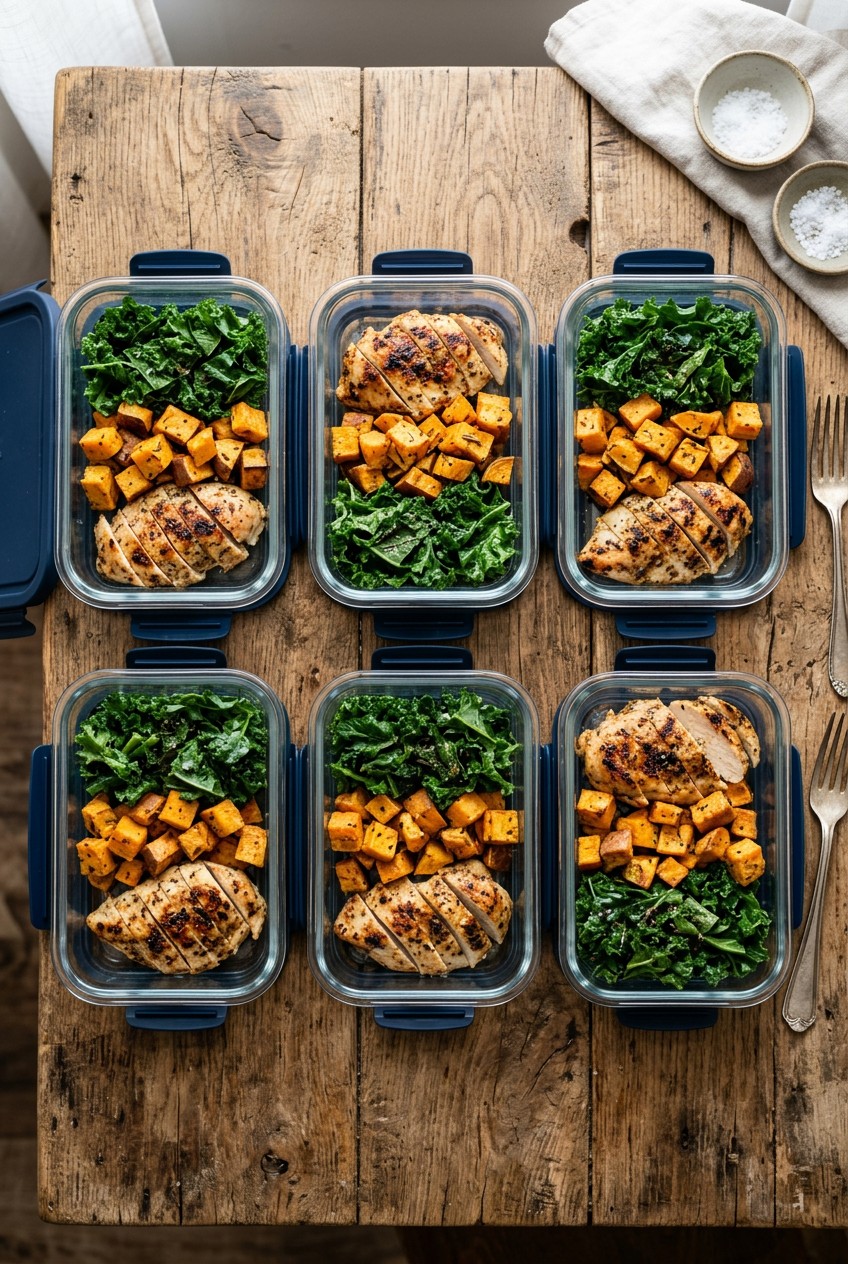
What’s Inside
- Why I Finally Ditched the 3-Hour Sunday Kitchen Prison
- Master the 333 Method for Healthy Lunch Meal Prep For The Week
- Batch Cook One “Anchor” Protein to Save Your Budget
- Use Ready-Made Shortcuts (And Don’t Feel Guilty)
- Weigh Your Portions for Perfect Healthy Lunch Meal Prep For The Week
- Build a Bulletproof Spice Toolkit to Ban Blandness
- Invest in Glass Containers That Won’t Leak in Your Bag
- Cool Your Food Rapidly Before Refrigeration (The Safety Rule)
- Treat Your Freezer Like a Backup Parent
- My Go-To 30-Minute Grocery Strategy
- The Final Step to Keep Your Lunches Fresh All Week
I sat on my sticky kitchen floor at 11 PM last Tuesday, crying over a Tupperware of gray, unseasoned chicken breast. I’d spent three hours trying to master healthy lunch meal prep for the week, and all I had to show for it was a sink full of crusty pans and a kitchen that smelled like boiled sadness. I tried this wrong for months before figuring it out. Honestly, I used to think meal preparation meant sacrificing my entire weekend to chop onions until my eyes swelled shut. If you’re tired of wasting your Sunday chained to the stove, I completely understand. We aren’t doing that anymore. Let’s fix this mess together with a system that actually works for busy people.
Why I Finally Ditched the 3-Hour Sunday Kitchen Prison

Most people get this wrong right out of the gate. They try to cook five intricate, restaurant-quality meals from scratch on a Sunday afternoon. I did this last month. I bought a cart full of expensive produce at Whole Foods, tried to make three different glazes, and ended up burning a $15 piece of salmon while my quinoa boiled over. The smell of scorched fish lingered in my apartment for days. It’s exhausting, and it won’t actually help you stick to your goals. Instead, I shifted to the assembly-line method. This completely changed how I look at my Sunday afternoons.
Instead of cooking full meals, I focus on preparing individual components that I can quickly throw together. I’ll grab a Kirkland Signature Rotisserie Chicken from Costco for exactly $4.99. I shred the meat while it’s still warm (it falls apart so much easier this way—learned that the hard way). Then I pair it with a microwave-ready pouch of Seeds of Change Brown Rice and Quinoa, which costs about $2.99 at Target. I add a bag of frozen steamed broccoli florets. Just like that, I have the base for four lunches done in ten minutes. The texture of the freshly shredded chicken is infinitely better than the rubbery cubes I used to bake in the oven. Skip the complicated recipes. You’re just setting yourself up for failure and a massive pile of dishes.
1. Master the 333 Method for Healthy Lunch Meal Prep For The Week

I personally swear by the 333 meal prep method. This is a big trend I’ve seen exploding for 2026, and it’s the only thing that keeps me from getting incredibly bored by Wednesday. The concept is simple. You choose three proteins, three carbohydrates, and three vegetables for your weekly rotation. When I shopped at Trader Joe’s last Thursday, I picked up a pack of their organic chicken thighs, a carton of large brown eggs (usually around $3.99 a dozen), and a block of extra firm tofu ($1.99). For carbs, I grabbed sweet potatoes, quinoa, and whole wheat wraps. For veggies, I chose bell peppers, cucumbers, and a bag of shredded carrots.
This variety stops the dreaded flavor fatigue. You can batch cook the chicken thighs, quinoa, and roasted broccoli for one set of meals. Then, you switch to a hard-boiled egg and tofu wrap with fresh cucumber slices for the next day. I used to eat the exact same dry turkey and rice bowl five days in a row. By Thursday, the texture felt like wet sawdust in my mouth, and I’d inevitably end up ordering a $20 salad on DoorDash instead. The 333 method forces you to mix up your textures and flavors. Plus, pre-chopping those brightly colored bell peppers and storing them separately keeps them incredibly crisp. Aim for three to four different colors in your containers to maximize your nutrients.
2. Batch Cook One “Anchor” Protein to Save Your Budget

If you’re trying to keep your grocery bill down, you need to build your meals around cost-effective “anchor” proteins. I learned this the hard way after spending $40 on pre-cooked steak strips at Sprouts that tasted like literal shoe leather. Now, I head straight to the poultry section at Walmart. I grab a 3-pound family pack of bone-in, skin-on chicken thighs. They usually cost around $6 to $8 total. That breaks down to about $0.035 to $0.055 per gram of protein. It’s an absolute steal compared to pre-packaged deli meats.
Chicken thighs are incredibly forgiving. Unlike chicken breasts, which turn into dry chalk if you look at them wrong, thighs stay juicy and tender even after three days in the fridge. I roast the entire 3-pound batch on a single sheet pan with a heavy drizzle of olive oil and salt. Once they cool, I pull the meat off the bones. This yields about five to seven generous servings. I can toss this shredded chicken into a grain bowl on Monday, wrap it in a tortilla on Tuesday, and mix it with a huge green salad on Wednesday. If you prefer plant-based options, lentils are fantastic. A half-cup serving gives you 9 grams of protein, and a one-pound bag of Goya brown lentils costs about $1.69. Batch cooking one reliable anchor protein is the foundation of cheap, stress-free lunches. You might also like: 15 Brilliant Batch Cooking Ideas That Actually Work
![[8-Pack,30 oz]Glass Meal Prep Containers](https://m.media-amazon.com/images/I/713Zfdsgi4L._AC_UL320_.jpg)
[8-Pack,30 oz]Glass Meal Prep Containers
Honestly, [8-Pack surprised me — sturdier than it looks in the photos, and over 7 buyers gave it 4.5 stars.
3. Use Ready-Made Shortcuts (And Don’t Feel Guilty)

The biggest lie the internet tells you is that every single ingredient must be chopped by hand. I spent years peeling and mincing fresh ginger root, ending up with scraped knuckles and a messy cutting board. The biggest barrier to consistent meal prep is time. If you don’t have time, you won’t do it. Now, I aggressively utilize ready-to-use products, and I don’t feel a single ounce of guilt about it. You might also like: 15 Creative Cold Lunch Ideas to Transform Your Space
My absolute favorite shortcut is Spice World Minced Garlic. A large jar costs about $4.50 at Kroger, and it saves me at least ten minutes of sticky, smelly prep work. I also rely heavily on Amore Squeezable Ginger paste ($4.99). You just squeeze a dime-sized amount into your stir-fry or salad dressing, and you get that intense, spicy ginger kick without any of the fibrous strings. I also buy pre-washed, pre-chopped kale and frozen vegetable medleys. Frozen vegetables are picked at peak ripeness and flash-frozen, meaning they are just as nutritious as fresh ones. I used to turn my nose up at frozen broccoli, thinking it would be mushy. But if you roast it straight from the freezer at 425 degrees, the edges get beautifully crispy and caramelized. Stop making things harder than they need to be. Buy the shortcuts. You might also like: 20 Inspiring Meal Prep Ideas for Any Style
4. Weigh Your Portions for Perfect Healthy Lunch Meal Prep For The Week

I resisted buying a food scale for years because I thought it was only for hardcore bodybuilders. I was completely wrong. If you aren’t seeing the results you want, or if you find yourself starving by 2 PM, your portions are probably completely off. I used to “eyeball” my peanut butter, thinking I was adding a modest spoonful to my oatmeal. When I finally measured it, I realized my “spoonful” was actually four tablespoons.
I highly recommend grabbing a Vitafit Food Scale. I got mine for exactly $13.99 on Amazon. It’s sleek, easy to wipe down, and fits right in my silverware drawer. Using a scale allows you to accurately measure your protein. Experts recommend aiming for 20 to 35 grams of protein per meal to maintain muscle and stay full. For chicken, that’s about 4 to 5 ounces of cooked meat. I also use the scale to measure my healthy fats. Fats are crucial for brain function and keeping you satisfied, but they add up quickly. I’ll weigh out exactly 30 grams of avocado (about a quarter of a medium avocado, roughly 70-80 calories) or two tablespoons of Jif Natural Peanut Butter ($2.50 for a 16-ounce jar at Target). Weighing your food takes an extra ten seconds per container, but it completely changes your macro accuracy.
5. Build a Bulletproof Spice Toolkit to Ban Blandness

A frequent complaint I hear from friends about meal prep is that the food tastes incredibly boring by Wednesday. I completely agree. If you’re only using salt and pepper, you’re going to hate your lunches. I combat this by building a dedicated “spice toolkit.” You can transform the exact same base ingredients into entirely different flavor profiles just by switching up the seasoning.
Skip the fat-free, sugar-free bottled sauces. They usually taste like wet cardboard and have a slimy texture. Instead, invest in high-quality dry blends. I’m obsessed with Trader Joe’s 21 Seasoning Salute, which costs just $1.99. It has a beautiful, savory blend of onion, black pepper, celery seed, and lemon juice powder. I’ll sprinkle it heavily over my roasted vegetables. For my proteins, I use McCormick Gourmet Garam Masala ($5.49 at Whole Foods) to give shredded chicken a warm, earthy curry flavor. On a different day, I’ll toss ground turkey in a cheap packet of Old El Paso Taco Seasoning ($1.25) for a quick taco bowl. By keeping three or four strong, distinct spice blends in your pantry, you trick your brain into thinking you’re eating a brand new meal every single day. Don’t be shy with the spices. If the chicken looks pale, you haven’t used enough.

KOMUEE 10 Packs 30 oz Glass Meal Prep Containers
KOMUEE 10 Packs 30 oz Glass Meal Prep Containers has been one of the most consistently praised picks in this category. 45 reviewers averaged 4.5/5.
6. Invest in Glass Containers That Won’t Leak in Your Bag

Let me paint a picture for you. It was a rainy Tuesday morning, and I was rushing to catch the train. I tossed my flimsy plastic meal prep container into my canvas tote bag. By the time I got to my desk, my entire bag smelled like balsamic vinaigrette. The plastic lid had popped off, and dressing had soaked into my planner, my laptop sleeve, and my favorite sweater. I learned my lesson. You must invest in quality glass containers for safety, longevity, and your own sanity.
I exclusively use the Starfrit LocknLock Borosilicate Glass Divided Containers (Set of 4). They usually run between $30 and $45 depending on where you buy them, but they are worth every single penny. The snap-on lids have a thick silicone gasket that creates an airtight, leak-proof seal. I can literally hold them upside down and shake them. Plus, glass is recommended by Consumer Reports because it lasts five to ten times longer than plastic. It won’t stain when you store tomato sauce, and it prevents chemical leaching when you reheat your food in the office microwave. The Harvard T.H. Chan School of Public Health actually warns that reheating certain plastics can cause hormone-disrupting chemicals like BPA and phthalates to leach into your lunch. If you want a slightly cheaper option, the Rubbermaid Brilliance Glass Set is about $29.99 at Target. Also, always store your dressings separately. I use a tiny Bayco container set ($19.99 on Amazon) just for condiments so my greens stay crisp.
7. Cool Your Food Rapidly Before Refrigeration (The Safety Rule)

This is a massive mistake I see constantly on Instagram and TikTok. Influencers will pull a steaming hot pan of roasted sweet potatoes right out of the oven, dump it into a container, snap the lid on tight, and shove it directly into the fridge. I tried this once, and the next day, my potatoes were a soggy, mushy disaster. The condensation builds up on the lid and drips right back down onto your food, ruining the texture completely.
More importantly, it’s a huge food safety hazard. Putting hot food into your refrigerator raises the internal temperature of the entire fridge, potentially putting your other groceries at risk of bacterial growth. A surprising tip for food safety is to allow your cooked food to cool to room temperature within two hours before refrigerating. I spread my hot chicken and roasted veggies out on a large baking sheet so they cool rapidly. Once they stop steaming, I portion them into my glass containers. Your refrigerator needs to maintain a temperature below 40 degrees Fahrenheit (ideally between 3 and 5 degrees Celsius) to inhibit bacterial growth. Also, you must label and date everything. I use a piece of blue painter’s tape and a Sharpie to write the date on the lid. Always follow the “first in, first out” rule. Most prepped foods are perfectly safe for three to five days, but you don’t want to play guessing games with four-day-old fish. Trust me on this.
8. Treat Your Freezer Like a Backup Parent

I honestly don’t know how I survived before I started utilizing my freezer properly. Sometimes, life just gets in the way. You get sick, you have to work late, or you simply don’t have the energy to prep on a Sunday. This is when your freezer swoops in like a backup parent to save the day. A trending hack for busy individuals in 2026 is to intentionally prep double batches of freezable components.
Don’t let excess prepped food go to waste. If I find a great deal on lean ground beef at Kroger (sometimes I catch it on sale for $4.99 a pound), I’ll brown three pounds of it with onions and garlic. I use one pound for the current week and freeze the other two pounds in flat, labeled Ziploc freezer bags. Laying the bags flat saves so much space. Cooked components like ground beef, shredded chicken, and even cooked brown rice freeze beautifully for up to two or three months. When I have a “no-cook” night, I just pull a flat frozen block of taco meat out, run it under warm water for a minute, and heat it in a skillet. It tastes incredibly fresh, and it prevents me from ordering expensive takeout. Just remember that things with high water content, like cucumbers or lettuce, won’t freeze well. Stick to proteins and hearty grains.

M MCIRCO 10-Pack,22 Oz Glass Meal Prep Containers
A dependable everyday pick — M MCIRCO 10-Pack pulls in 86 ratings at 4.5 stars. Not flashy, just solid.
My Go-To 30-Minute Grocery Strategy

You can’t execute a 30-minute prep session if you spend two hours wandering aimlessly around the grocery store. I used to go shopping without a list, grab whatever looked good, and end up with a cart full of random snacks and zero actual meals. Now, I have a strict strategy. I map out my grocery list based on the layout of my local Sprouts. I start in the produce section, grabbing my three colorful veggies (usually bell peppers, zucchini, and cherry tomatoes).
Then, I immediately hit the meat counter for my anchor protein. I skip the middle aisles entirely unless I specifically need a restock on my staple grains or olive oil. The middle aisles are where you get distracted by overpriced, processed junk food. Speaking of snacks, many people make the fatal mistake of only prepping their main meals. By 3 PM, they’re starving and reaching for stale donuts in the office breakroom. I always plan for grab-and-go snacks. I’ll boil a dozen eggs (they last three to four weeks in their shells in the fridge) or buy pre-portioned Good & Gather Greek Yogurt from Target. Greek yogurt costs about $0.040 to $0.080 per gram of protein and keeps me full until dinner. Get in, stick to the perimeter of the store, and get out. Your time is too valuable to spend comparing labels on twelve different boxes of crackers.
The Final Step to Keep Your Lunches Fresh All Week

If you implement even half of these strategies, your weekly routine will feel infinitely lighter. I personally swear by the combination of the 333 method and high-quality glass containers. It’s the only system that has consistently kept me on track without making me feel like a tired, grumpy cafeteria worker in my own home. I’ve ruined enough salmon and scrubbed enough leaky plastic containers to know that simple is always better.
Start small this week. Buy a rotisserie chicken, grab some frozen broccoli, and weigh out a proper portion of peanut butter for your snack. You’ll be amazed at how much mental energy you save when you aren’t stressing about what to eat at noon every day. If you found this helpful, I’d love it if you pinned this article to your favorite Pinterest board so you can reference my grocery tips next Sunday. You’ve got this. No exaggeration. Now go enjoy your weekend outside of the kitchen.
Frequently Asked Questions
How long do prepped lunches stay fresh in the fridge?
Most cooked proteins and vegetables will stay fresh and safe to eat for 3 to 5 days in the refrigerator. Use airtight glass containers and store dressings separately to maintain the best texture and flavor.
Can I freeze my meal prep containers?
Yes, many cooked components like shredded chicken, ground beef, and rice freeze beautifully for 2 to 3 months. Avoid freezing vegetables with high water content like cucumbers or lettuce, as they become mushy when thawed.
What is the 333 meal prep method?
The 333 method involves choosing 3 proteins, 3 carbohydrates, and 3 vegetables for your weekly prep. Mixing and matching these components prevents flavor fatigue and ensures a balanced, nutrient-dense diet throughout the week.
Are glass containers really better than plastic?
Glass containers are highly recommended because they don’t absorb odors, won’t stain, and last much longer than plastic. They also prevent harmful chemicals like BPA from leaching into your food when reheating in the microwave.
