What’s Inside
- Master the Split-Week Strategy for Optimal Freshness
- Stop Overcooking Your Fish with a Digital Thermometer
- Always Pat Your Fish Dry for a Perfect Sear
- Embrace High-Quality Canned Seafood as a Pantry Staple
- Utilize the Marinade-Then-Freeze Method for Deep Flavor
- Invest in Quality, Segmented Glass Meal Prep Containers
- Incorporate Plant-Based Fillers to Stretch Your Seafood
- Reheat Your Seafood Gently to Preserve Texture
- My Essential Frozen Seafood Stash
- How to Portion Your Meals Correctly
- Fast-Cooking Varieties for Lazy Sundays
Last Tuesday at Whole Foods, I stood over a trash can throwing away three days of spoiled, slimy tilapia. The smell hit my nose like low tide on a hot summer afternoon. It was completely wretched. That was my absolute rock bottom with pescatarian meal prep. I tried this wrong for months before figuring it out. You can’t just treat delicate fish fillets the same way you treat tough chicken breasts. It requires a totally different strategy. If you prep a massive batch of fish on Sunday and expect it to taste fresh by Thursday, you’re setting yourself up for a smelly, mushy disaster. I’ve ruined so many expensive cuts of salmon by ignoring the basic rules of seafood storage.
I’m writing this because I want to save you from eating rubbery shrimp and stinking up your office kitchen. Skip the fat-free stuff. It tastes like wet cardboard. We’re going to use real ingredients, real butter, and smart techniques. I’ve got a system now that actually works, keeping my lunches fresh and my grocery budget reasonable. Let’s look at the exact methods, specific products, and hard lessons I’ve learned along the way. Trust me on this.
1. Master the Split-Week Strategy for Optimal Freshness

Most people get this wrong right out of the gate. They cook five days of fish on Sunday afternoon. By Wednesday, that fish is breaking down, smelling fishy, and completely losing its texture. To adhere to the FDA and USDA recommendations of consuming cooked seafood within 3-4 days, you absolutely must plan your prep in two phases. I personally swear by the split-week strategy. It fixed my soggy lunch problem completely.
Here’s how I do it. On Sunday, I prepare enough fresh seafood for Monday, Tuesday, and Wednesday. I usually grab a beautiful cut of Atlantic salmon from Costco. Their farm-raised Atlantic salmon runs about $12.99 per pound, which is a fantastic deal. I’ll cook three portions, each weighing exactly 5 oz, and store them in the fridge. Then, on Wednesday night, I do a second mini-prep for Thursday and Friday.
If I’m feeling lazy on Wednesday, I won’t even cook fresh fish. I’ll just pull from my stash of high-quality canned options or frozen shrimp that cook in literally four minutes. This approach prevents spoilage and keeps the texture of your meals actually enjoyable. I’ve eaten four-day-old cod before, and it’s a mistake I won’t repeat. The flesh gets chalky and the smell permeates every corner of the fridge. Stick to the split-week method. Your taste buds and your coworkers will thank you.
2. Stop Overcooking Your Fish with a Digital Thermometer

I ruined a perfectly good batch of expensive halibut last month because I walked away from the stove for two minutes. A common mistake is cooking fish to the same internal temperature as poultry, which is 165°F. If you do this to seafood, you’ll end up with dry, rubbery results that bounce when you drop them. You can’t chew through overcooked swordfish without a struggle. No exaggeration.
You need to rely on a digital meat thermometer. I use a simple Target Up&Up digital thermometer that cost me exactly $14.99. It’s cheap, fast, and completely foolproof. The secret is carryover cooking. You must remove the fish from the heat when its internal temperature is 5-10°F below your actual target. For example, if I want a beautiful medium-rare finish on my salmon, I pull it off the hot cast iron pan the second the thermometer hits 125°F.
The residual heat inside the fish will continue to cook the center while it rests on your cutting board. When I finally figured this out, my meal prep improved drastically. No more dry, flaky messes that require a gallon of tartar sauce just to swallow. Invest the fifteen bucks in a thermometer. It pays for itself the very first time you don’t ruin a $20 piece of fish.
3. Always Pat Your Fish Dry for a Perfect Sear

Honestly this changed how I cook entirely. For the longest time, I couldn’t figure out why my fish always stuck to the pan and looked pale and sad. I was pulling wet fillets straight from the packaging, tossing them into hot oil, and wondering why they steamed instead of searing. Wet fish will never, ever develop a crispy skin. The moisture turns into steam, which drops the temperature of your pan instantly.
You have to thoroughly pat your fish fillets dry with paper towels before they ever touch a hot pan. I buy Bounty paper towels (specifically the 2-roll pack for $5.99 at Walmart) just for this purpose because cheap paper towels leave little white fibers all over the meat. I take my 6 oz portions of fresh trout, lay them on a plate, and press the paper towels firmly against both sides until the surface feels tacky and completely dry.
This simple step improves the texture by at least 50 percent. When that dry skin hits a hot skillet with 1 tbsp of olive oil, it sizzles aggressively. You get that gorgeous, golden-brown crust that holds up surprisingly well in a meal prep container. If you skip this step, you’re guaranteed a soggy, unappealing lunch. I’ve eaten enough steamed, gray tilapia to know that taking thirty seconds to dry your fish is absolutely non-negotiable.

Vtopmart 5Pack 22oz Glass Storage Containers with Lids
Vtopmart 5Pack 22oz Glass Storage Containers with Lids has been one of the most consistently praised picks in this category. 32 reviewers averaged 4.5/5.
4. Embrace High-Quality Canned Seafood as a Pantry Staple

Don’t overlook the canned food aisle. When I first started pescatarian meal prep, I thought I had to buy fresh fillets every single week. My grocery bill was astronomical. Then I discovered the magic of premium canned seafood. When packed in olive oil, canned fish is rich in omega-3s, has a massive shelf life, and costs pennies compared to the fresh counter. You might also like: 20 Clever Aesthetic Food Prep That Actually Work
Skip the fat-free stuff packed in water. It tastes like wet cardboard and lacks the healthy fats that keep you full. I exclusively buy Starkist solid white albacore tuna packed in olive oil. You can find a 5 oz can at Walmart for exactly $1.79. I also stock up on King Oscar wild-caught sardines in extra virgin olive oil, which run about $2.99 a tin at Kroger. These are absolute lifesavers for the back half of the week when my fresh prep runs out. You might also like: 20 Clever School Lunch Ideas You Can Try Today
I like to mix one 5 oz can of tuna with 2 tbsp of plain Greek yogurt, 1 tbsp of Dijon mustard, and a handful of diced celery. It makes a rich, satisfying tuna salad that takes three minutes to prep. I’ll scoop this over 2 cups of mixed greens for a fast Thursday lunch. The global canned tuna market is booming right now for a reason. It’s cheap, it’s packed with protein, and it won’t spoil in your fridge. You might also like: 15 Gorgeous Chicken Breast Dinner Ideas That Make a Real Difference
5. Utilize the Marinade-Then-Freeze Method for Deep Flavor

This technique is brilliant for those busy weeks when you can’t stand the thought of cooking. I prep my marinades and freeze the raw fish directly in the sauce. As the fish thaws in the fridge overnight, it absorbs all those incredible flavors. By the time you cook it, it tastes like it came from a high-end restaurant.
My absolute favorite combination is a Greek yogurt marinade. The lactic acid gently tenderizes the fish without turning it into mush. I mix 1/2 cup of plain Greek yogurt (I use Trader Joe’s whole milk Greek yogurt, $3.49 for a 16 oz tub), 2 tbsp of fresh chopped mint, 2 tbsp of fresh parsley, 2 tbsp of fresh basil, and 2 pressed garlic cloves. I drop four 6 oz salmon fillets into a heavy-duty zip-top bag, pour the marinade over them, squish it all around, and toss it in the freezer.
When I know I’ve got a busy prep day coming up, I pull the bag out on Saturday night. It thaws perfectly by Sunday afternoon. The caramel-butter smell of the garlic and fresh herbs hits you the second you open the bag. Just be careful with acidic marinades. If you use heavy citrus like lemon or lime juice, don’t freeze it. Strong acids will actually cook the delicate fish, giving you a weird, rubbery ceviche texture. Stick to yogurt or oil-based marinades for freezing.
6. Invest in Quality, Segmented Glass Meal Prep Containers

If you take away nothing else from this article, please listen to this: throw away your cheap plastic containers. I kept putting leftover shrimp scampi into thin plastic tubs. After a month, every single container I owned smelled permanently like garlic and old shrimp. I couldn’t wash the smell out, even with boiling water and baking soda. Plastic is porous, and it traps fish oils like a sponge. Learned that the hard way.
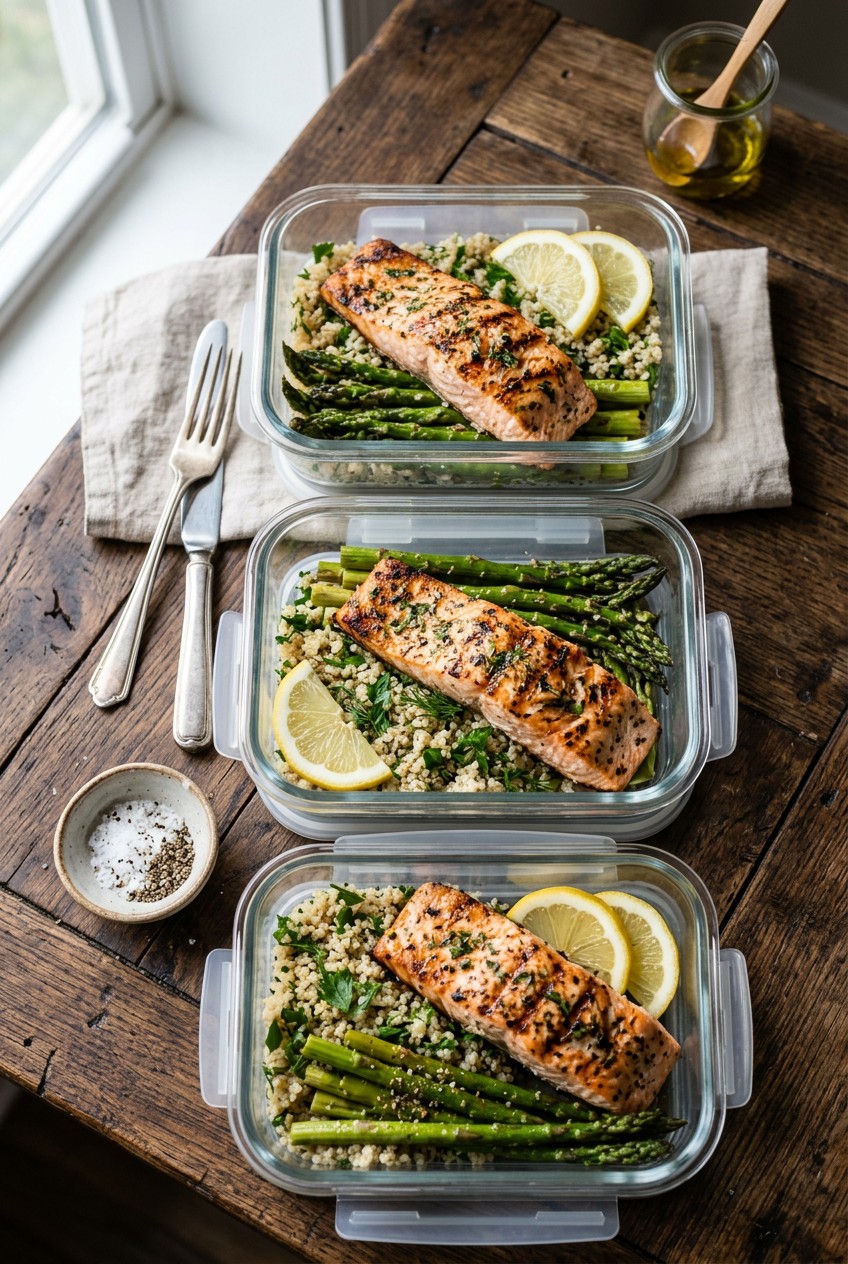
Durable, leak-proof glass containers are strictly mandatory for pescatarian meal prep. Dietitians strongly recommend glass over plastic for reheating to avoid chemical leaching, but honestly, I just do it for the smell. I bought a 5-piece set of Rubbermaid Brilliance glass containers from Target for $24.99. They have an airtight seal that actually works. I can carry a piece of baked cod in my tote bag on the subway, and nobody smells a thing.
I also highly recommend Prep Naturals glass containers with dividers, which usually run about $28 for a set of five on Amazon. The dividers keep your wet vegetables from touching your crispy fish skin. Nothing is worse than roasted zucchini leaking liquid all over a perfectly seared piece of salmon. Glass is heavier to carry, but it’s worth every single penny to avoid eating lunch out of a stinky, stained plastic tub.

8 Pack 36oz Large Glass Meal Prep Containers with lids
If you want something that just works, 8 Pack 36oz Large Glass Meal Prep Containers with lids is a safe bet (866 reviews, 4.5 stars).
7. Incorporate Plant-Based Fillers to Stretch Your Seafood

Buying six pounds of fresh fish every week gets incredibly expensive. To make my pescatarian meals more filling and budget-friendly, I constantly combine my seafood with hearty plant-based components. Legumes, beans, lentils, and tofu are cheap, packed with fiber, and do an amazing job of bulking up a meal without overpowering the delicate flavor of the fish.
I buy organic garbanzo beans from Sprouts. A 15 oz can costs just $1.29. I will rinse them thoroughly and toss 1/2 cup of chickpeas into my meal prep containers alongside a smaller 4 oz portion of shrimp. The nutty flavor of the chickpeas pairs beautifully with the sweet, briny shrimp. It stretches my expensive seafood much further, meaning a single bag of frozen shrimp can easily last me through five meals instead of three.
Another trick I love is adding 1/2 cup of cooked green lentils to a simple fish stew or serving my baked tilapia over a massive bed of quinoa instead of plain white rice. This strategy manages the cost of the protein while adding massive amounts of necessary fiber. I used to eat just fish and broccoli, and I’d be starving by 3 PM. Adding these cheap, plant-based fillers completely solved my afternoon hunger crashes.
8. Reheat Your Seafood Gently to Preserve Texture

We need to talk about the office microwave. Last year, my coworker glared at me for a solid ten minutes because I microwaved a piece of leftover halibut on high for two minutes. The smell cleared the entire breakroom. Not only is microwaving delicate fish socially unacceptable, but it also destroys the meat. The high, uneven heat boils the water inside the fish, rendering it completely unpalatable and tough.
You have to reheat seafood gently. If I’m working from home, I always use my oven. I place the leftover fish on a baking sheet lined with Kroger Reynolds Wrap aluminum foil (which costs $4.49 a roll). I add a tiny splash of water to the pan, cover the fish loosely with another piece of foil, and bake it at 275°F for about 12 to 15 minutes. The low heat and trapped steam warm the fish perfectly without drying it out.
If you’re stuck at an office and absolutely must use a microwave, use the 50 percent power setting. Heat it in 30-second bursts, checking it constantly. Honestly, I’d rather just eat my meal prep cold. Cold poached salmon over a crisp salad is incredibly delicious and completely eliminates the risk of ruining the texture or making your coworkers hate you.
My Essential Frozen Seafood Stash

I can’t stress enough how much money you save by shopping in the freezer aisle. Fresh fish at the seafood counter is wonderful, but it’s often just previously frozen fish that the butcher thawed out that morning. You’re paying a premium for someone else to thaw your food. I skip the middleman and buy frozen fillets directly.
My freezer is always stocked with Marine Harvest frozen salmon fillets from Costco. A 24 oz bag costs $18.99, and the portions are already cut into perfect 6 oz squares. This makes portion control incredibly easy. I also buy large bags of frozen wild-caught cod, which is often 40 percent cheaper than the fresh cod sitting on ice at the grocery store. Frozen fish is flash-frozen at sea, meaning it’s often fresher than the unfrozen fillets sitting behind the glass.
The trick to frozen fish is thawing it safely. I never leave it on the counter. I place the vacuum-sealed portions in a bowl of cold water in the fridge overnight. If you try to rush the process with hot water, you’ll partially cook the edges of the fish while the center remains frozen solid. I’ve done this before, and the resulting texture is completely ruined. Plan ahead, use the fridge, and save yourself a ton of cash.

KOMUEE 10 Packs 30 oz Glass Meal Prep Containers
KOMUEE 10 Packs 30 oz Glass Meal Prep Containers has been one of the most consistently praised picks in this category. 45 reviewers averaged 4.5/5.
How to Portion Your Meals Correctly

When I first started prepping, I was completely guessing my portion sizes. Some days I’d pack a massive 8 oz slab of salmon, and other days I’d barely have 3 oz of shrimp. I felt sluggish on the heavy days and starving on the light days. Figuring out exact portions stabilized my energy levels and made my grocery shopping completely predictable.
For individual meal prep, I aim for exactly 4 ounces of cooked fish for lunch, and 5 to 6 ounces of cooked fish for dinner. If you’re starting with raw fish fillets, remember that they lose about 25 percent of their weight during cooking due to water loss. So, I plan for 6 to 8 ounces of raw fish per person when I’m writing my grocery list.
I follow a very specific formula for building my glass containers. I aim for 35 percent seafood protein (usually 4 to 6 oz), 25 percent complex carbohydrates (like 3/4 cup of cooked brown rice or sweet potatoes), 30 percent non-starchy vegetables (like 1.5 to 2 cups of roasted broccoli or asparagus), and 10 percent healthy fats (like a drizzle of olive oil or a quarter of an avocado). This exact ratio keeps me full, prevents afternoon sugar cravings, and ensures I’m getting a balanced diet. I measure everything with a cheap digital food scale I bought on Amazon for ten bucks.
Fast-Cooking Varieties for Lazy Sundays

We all have those Sundays where meal prep feels like an impossible chore. When I’m exhausted, I completely avoid thick cuts of fish that require careful monitoring. Instead, I lean heavily into fast-cooking varieties that require almost zero effort. Incorporating fish that cook rapidly into your rotation is the ultimate hack for time efficiency.
Tilapia is an incredibly affordable, mild option that cooks in literal minutes. But my absolute favorite lazy prep is shrimp. Shrimp cooks so fast you can barely blink. I love making a Sheet Pan Mediterranean Shrimp recipe. I take 1 pound of raw, peeled shrimp and toss it on a baking sheet with 2 cups of chopped zucchini, 1 cup of cherry tomatoes, and 1 sliced bell pepper. I drizzle the whole thing with 2 tbsp of olive oil and a heavy pinch of salt and oregano.
I roast it at 400°F for exactly 8 minutes. The shrimp turns perfectly pink, the tomatoes burst, and the zucchini gets tender. I divide this into four containers over a bed of quinoa. The entire process, from chopping to washing the sheet pan, takes less than twenty minutes. It reheats beautifully and the juices from the tomatoes create a natural sauce. You don’t always need a complicated, multi-step recipe to eat well. Sometimes, a hot oven and a bag of shrimp are all you need.
Pescatarian meal prep completely changed my weekly routine, but it took a lot of trial and error to get here. I’ve eaten my fair share of terrible, rubbery fish so you don’t have to. Stick to the split-week method, buy a meat thermometer, and please, throw away those smelly plastic containers. If you found these tips helpful, I’d love it if you pinned this article to your favorite recipe board on Pinterest so you can easily find it on your next prep day!
Frequently Asked Questions
How long does pescatarian meal prep last in the fridge?
According to the FDA, cooked seafood should be consumed within 3 to 4 days. For optimal freshness, use a split-week strategy: prep meals for Monday through Wednesday on Sunday, and do a second quick prep on Wednesday night.
Can I microwave my pescatarian meal prep?
It’s highly discouraged. Microwaving delicate fish often results in a rubbery texture and a strong odor. Instead, reheat your seafood gently in an oven at 275°F for 15 minutes, or enjoy it cold over a fresh salad.
What are the best containers for pescatarian meal prep?
Always use glass containers with airtight seals, like Rubbermaid Brilliance or Pyrex. Plastic containers are porous and will permanently absorb fish oils and odors, ruining your future meals.
How do I prevent my fish from getting soggy?
Always pat your raw fish fillets completely dry with paper towels before cooking. Removing surface moisture prevents the fish from steaming in the pan, allowing it to develop a delicious, crispy sear.
