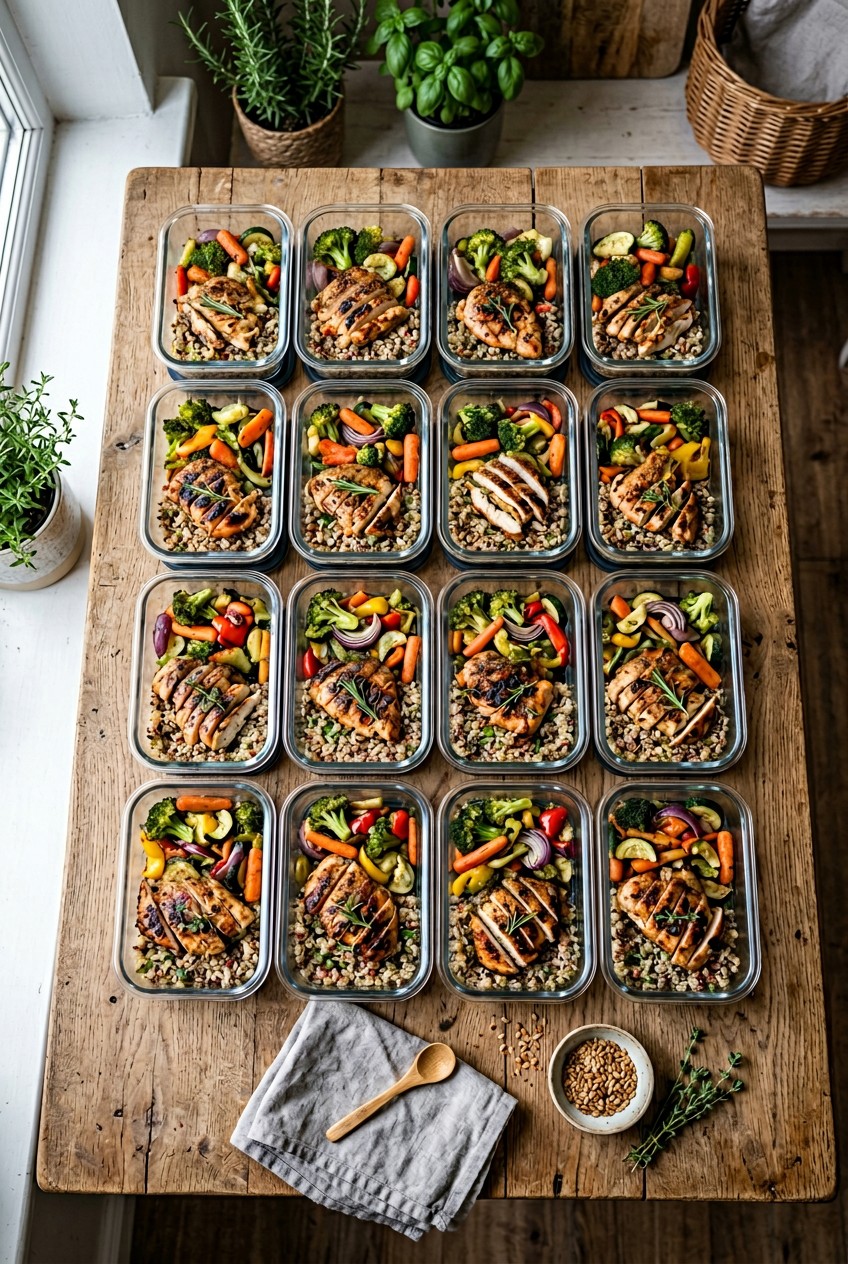
What’s Inside
- Start Small With Easy Meal Prep For The Week
- Batch Cook Components Instead Of Full Meals
- Prioritize Your Protein Prep First
- Master Vegetable Storage So Things Stop Rotting
- Use The 333 Method For Easy Meal Prep For The Week
- Make Your Own Sauces To Fix Boring Food
- Stop Ignoring Your Freezer Space
- Only Pick Recipes That Actually Reheat Well
I’m standing in the produce aisle last Tuesday at Whole Foods, clutching a dripping bunch of organic kale. My cart has three boxes of overpriced crackers, a single lemon, and zero actual dinner plans. I realized right then that my approach to meal prep was a total disaster. I used to buy sixty dollars worth of random, beautiful vegetables, shove them into my dark crisper drawer, and just pray they magically turned into healthy lunches. Spoiler alert. They didn’t. They turned into a brown, foul-smelling slime that I had to scrape into the trash by Thursday evening. I tried this wrong for months—actually, it took me years to figure it out. You don’t need to spend your entire Sunday chained to a hot stove, sweating over twenty identical plastic containers. You just need a better, more realistic system.
The anxiety of Sunday night used to ruin my weekend. I’d stare at a messy kitchen, knowing I had nothing ready for Monday morning, and end up ordering a twenty-dollar salad on my lunch break. It’s a terrible cycle. But I’ve finally cracked the code on making this habit stick without losing my mind. Let’s fix your sad fridge situation. I’ll walk you through exactly how I stopped wasting expensive groceries and started actually looking forward to eating my leftovers. Grab a coffee, pull out your grocery list, and let’s get into the specifics of making your kitchen work for you.
1. Start Small With Easy Meal Prep For The Week

Most people get this completely wrong on their very first try. I know I did. I decided I was going to be a fitness model overnight, so I cooked twenty-one identical meals on a Sunday afternoon. By Wednesday, the smell of day-old steamed broccoli made me gag. I ended up throwing away half the food and ordering a pizza. Don’t overcommit. You aren’t running a commercial kitchen. Instead, begin by prepping just two or three meals for your absolute busiest days. For me, that’s Tuesday and Wednesday lunches.
When you start small, you protect your sanity and your grocery budget. I swear by investing in good containers before you even buy the food. I bought a 10-piece set of Rubbermaid Brilliance containers for $29.99 at Target. They’re thick, crystal-clear plastic with locking lids that snap shut with a loud, satisfying click. They don’t leak oily dressing all over your bag. Prepping just three portions of a hearty salad or a rice bowl is manageable. It takes maybe forty-five minutes. You can scale up to five days once you’re comfortable, but right now, your only goal is to not hate the process. I can’t stress this enough. If you hate your Sunday routine, you won’t do it next week. Trust me.
2. Batch Cook Components Instead Of Full Meals

This single concept saved my weeknight dinners. Instead of making complete, identical meals that bore you, focus on preparing large quantities of versatile base ingredients. I’m talking about neutral proteins, simple grains, and roasted vegetables. Last Sunday, I bought a 3 lb family pack of Perdue Farms Boneless Skinless Chicken Breast for $6.49 per pound at Kroger. I didn’t make a complex casserole. I simply rubbed the breasts with 1 tablespoon of olive oil, 1 teaspoon of kosher salt, and baked them at 400 degrees until they were golden and juicy.
The beauty of this is the flexibility. On Monday, I slice that cold chicken and throw it into a Caesar salad. On Tuesday, I shred it with a fork, heat it in a skillet with 1/4 cup of salsa, and make quick tacos. On Wednesday, it goes into a quinoa grain bowl. You get different textures and flavors every day, which stops the boredom. I used to make the mistake of heavily seasoning my entire batch of chicken with strong curry powder. It tasted amazing on day one, but by day three, I couldn’t stomach the thought of eating curry again. Keep your base ingredients simple. You can always add the exciting sauces and spices right before you eat. You might also like: 20 Cozy High Protein Lunch Ideas for Any Style
3. Prioritize Your Protein Prep First

Protein takes the longest to cook, requires the most cleanup, and is usually the most expensive item on your receipt. If you only have time to prep one thing on a Sunday, make it your protein. Streamline your week by getting the raw meat out of the way. I’m a huge fan of ground turkey because it cooks in less than ten minutes. I usually grab two packages of Butterball 93% Lean Ground Turkey for $5.98 per pound at Walmart. You might also like: 15 Stunning Healthy Dinner Ideas to Steal Right Now
I toss the turkey into a hot, heavy cast-iron skillet. You want to hear that loud sizzle the second the meat hits the pan. I season it with 1 teaspoon of salt, 1/2 teaspoon of coarse black pepper, and 1 tablespoon of garlic powder. The savory smell of garlic fills the kitchen. Once it’s browned and crumbly, I let it cool completely before packing it away. Honestly, this changed how I handle my weeknights. I’ve had so many nights where I forgot to thaw meat, stared at a rock-hard block of chicken in the freezer at 6 PM, and just gave up. Having pre-cooked, seasoned ground turkey in the fridge means I’m five minutes away from a hot meal. You can toss it into pasta sauce, fold it into a wrap, or just eat it with a handful of spinach. You might also like: 20 Brilliant Quick Dinner Ideas You’ll Want to Bookmark

8 Pack 36oz Large Glass Meal Prep Containers with lids
8 Pack 36oz Large Glass Meal Prep Containers with lids has been one of the most consistently praised picks in this category. 866 reviewers averaged 4.5/5.
4. Master Vegetable Storage So Things Stop Rotting

We need to talk about produce storage, because throwing away rotten vegetables is basically throwing cash into the garbage. Harder vegetables like carrots and bell peppers are fantastic for prepping ahead, but only if you store them correctly. I used to chop cucumbers on a Sunday and wonder why they smelled like swamp water by Tuesday. Softer vegetables only last about three days once cut. Don’t touch your tomatoes or cucumbers until the day you plan to eat them.
For the hard veggies, I rely on my OXO Smart Seal Glass Container Sets. I bought an 8-piece set for $32.99 at Sprouts. Glass is heavy, but it doesn’t hold onto weird smells. Here is my exact routine. I peel and chop four large carrots into matchsticks. I put them in a glass container and cover them completely with cold tap water. They stay incredibly crisp, giving you that loud snap when you bite into them, even a week later. For bell peppers, I remove the core and seeds, slice them thin, and store them in a container with a dry paper towel folded at the bottom. The paper towel absorbs the excess moisture and totally prevents that gross, slimy texture. It’s a tiny extra step that saves so much food.
5. Use The 333 Method For Easy Meal Prep For The Week

If you get easily overwhelmed looking at Pinterest recipes, you need the 333 method. It’s a strict framework that stops you from overthinking. You simply pick 3 proteins, 3 carbs, and 3 vegetables for the week. That’s it. No complicated shopping lists. I used to walk into Trader Joe’s without a list, get overstimulated by the seasonal pumpkin snacks, and walk out with thirty dollars of junk food and zero actual meals.
Now, I stick to the formula. My go-to carb is Trader Joe’s Organic Tri-Color Quinoa. It costs $4.99 for a 16 oz bag. I measure out 1 cup of dried quinoa, rinse it well, and simmer it with 2 cups of chicken broth. It fills the house with a warm, nutty aroma. For my proteins, I might pick eggs, canned tuna, and my batch-cooked chicken. For veggies, I’ll grab spinach, cherry tomatoes, and sweet potatoes. Having these nine specific items ready means I can mix and match endlessly. I can make a quinoa bowl with chicken and spinach, or a sweet potato stuffed with tuna. It limits your choices just enough to remove the decision fatigue, but gives you enough variety that you aren’t eating the same bowl of mush every day.
6. Make Your Own Sauces To Fix Boring Food

I have a very strong opinion about this. Skip the fat-free, store-bought salad dressings. They taste like wet cardboard. A good homemade sauce will save a boring meal. When you’re eating pre-cooked chicken and plain rice on a Thursday, a bright, acidic sauce is the only thing that makes it palatable. I spend ten minutes on Sunday blending up a Creamy Avocado Lime Sauce, and it makes everything taste like it came from a restaurant.
Here is my exact recipe. I take 1 ripe avocado, 1/4 cup of full-fat Greek yogurt, 2 tablespoons of fresh lime juice, a handful of fresh cilantro, and 1/4 teaspoon of kosher salt. I blend it until it’s smooth. It has this vibrant, bright green color and a sharp, tangy citrus smell that wakes up your senses. I store it in small glass jars. I bought a 12-pack of 4 oz Ball Mason Jars for $17.49 at Target. They’re the perfect portion size for dressings. Just a drizzle of this creamy sauce over dry leftover chicken fixes the texture completely. Don’t skip the fat in your sauces. You need it to feel full. I tried doing the ultra-low-calorie thing for a while, and I was always starving by 3 PM. Learned that the hard way.

Skroam 10 Pack Glass Meal Prep Containers
Skroam 10 Pack Glass Meal Prep Containers has been one of the most consistently praised picks in this category. 56 reviewers averaged 4.5/5.
7. Stop Ignoring Your Freezer Space

Your freezer is the most underutilized tool in your kitchen. I used to think meal prep meant everything had to sit in the fridge, slowly degrading over five days. I’d force myself to eat slightly questionable chili just so I wouldn’t waste it. Then I discovered proper freezing techniques. You can freeze cooked proteins, soups, and stews for up to six months. But you can’t just throw a massive plastic container of soup into the icebox. I made that mistake, and I ended up trying to chip away at a solid block of frozen beef stew with a butter knife.
You need to freeze things in single-serving portions. I’m obsessed with Souper Cubes. I bought a 2-cup silicone tray for $19.99 at Whole Foods. They look like giant ice cube trays. I portion my leftover chili into the compartments, snap on the lid, and freeze it. The next day, you just push on the flexible silicone bottom, and a perfect, square brick of chili pops right out. I transfer those bricks into a labeled freezer bag. It completely prevents freezer burn, which happens when air touches the food and creates those gross, icy crystals. Now, I always have a backup meal ready to microwave on days when I’m too tired to cook.
8. Only Pick Recipes That Actually Reheat Well

This is the harsh truth about leftovers. Not everything is meant to be reheated in a microwave. I learned this the hard way when I tried to meal prep breaded chicken cutlets. When they came out of the oven on Sunday, they were incredibly crispy. When I microwaved them in the office breakroom on Tuesday, the breading turned into a soggy, wet, depressing paste. It was awful. Avoid crispy, fried, or delicately crusted foods entirely.
Instead, opt for dishes that taste better the next day as the flavors meld together. Stews, thick curries, grain bowls, and hearty casseroles are your best friends. I make a massive batch of vegetable stir-fry using my Fullstar 4-in-1 Vegetable Chopper. I got it for $29.99 at Costco, and the loud, aggressive smack of the lid pushing an onion through the stainless steel grates is my favorite sound in the kitchen. It cuts my chopping time from twenty minutes to two minutes. I toss those uniform veggies into a stir-fry with soy sauce and ginger. Vegetables cooked in a sauce reheat beautifully because they’re already soft and saturated with flavor. Set yourself up for success by choosing recipes that thrive in a plastic container, not ones that die in it.
If you’re feeling overwhelmed, just pick one of these strategies to try this weekend. Buy the glass containers, or try batch-cooking some ground turkey. You don’t have to be perfect. You just have to start. I’d highly recommend pinning this page or saving it to your bookmarks so you can reference the veggie storage tips and the 333 method before your next grocery run. You’ve got this!
Frequently Asked Questions
How many days ahead should I meal prep?
Start by prepping for just 2 to 3 days ahead. This prevents food spoilage and keeps you from getting bored with your meals. Most cooked proteins and chopped vegetables stay perfectly fresh in the fridge for about 3 to 4 days.
What is the 333 meal prep method?
The 333 method simplifies grocery shopping by limiting your choices to 3 proteins, 3 carbohydrates, and 3 vegetables for the week. You mix and match these nine base ingredients to create different bowls, salads, and wraps without decision fatigue.
How do I keep prepped vegetables crisp?
Store hard vegetables like carrots submerged in cold water in a glass container. For bell peppers, store them sliced in an airtight container with a dry paper towel to absorb excess moisture. Don’t cut soft veggies like cucumbers until you’re ready to eat.
What foods are best for easy meal prep for the week?
Focus on foods that reheat well and don’t lose their texture. Stews, curries, ground turkey, roasted root vegetables, and grains like quinoa are excellent. Avoid anything breaded, fried, or crispy, as it will become soggy in the microwave.
