What’s Inside
- 1. Prioritize Stable Plant-Based Proteins for Longevity
- 2. Master Tofu and Tempeh Preparation for Optimal Texture
- 3. Batch Cook Grains Using the Pasta Method
- 4. Strategically Pre-Chop Sturdy Vegetables
- 5. Embrace Component Cooking Over Full Meals
- 6. Master Flavor with Quality Store-Bought Sauces
- 7. Avoid the Over-Oiling Mistake for Better Reheating
- 8. Prioritize Food Safety and Freezer Storage
Last Tuesday at Whole Foods, I stood in the prepared foods aisle, staring down at a $14 plastic clamshell of wilted greens, three sad cherry tomatoes, and soggy tofu. That pathetic, overpriced salad was the exact moment I realized my vegetarian meal prep was a disaster. I’m Esperanza Eliza, and I’ve spent four years figuring out how to eat plant-based without emptying my bank account or settling for sad desk lunches. If you’re eating on a budget, winging it at the store doesn’t work. You need a plan. Seriously.
Vegetarian meal prep doesn’t mean eating boring rice and beans for five days. I did it wrong for months. I’d spend all Sunday chopping, only to open my fridge on Wednesday to find a container of slimy, unidentifiable mush. It’s frustrating to toss food you spent hours making. That’s why I overhauled my system to focus on ingredients that actually last. By making smart choices, I’ve gotten my weekly lunches and dinners down to under $5 per serving. Let’s break down the strategies, specific products, and hard-learned lessons that keep my fridge stocked with vibrant, delicious meals.
1. Prioritize Stable Plant-Based Proteins for Longevity

If you’re prepping for the week, you need proteins that last. I ruined my lunches last month at Sprouts. I bought 5 pounds of brown lentils, cooked a massive batch on Sunday, and by Thursday, I was eating a sandy paste that smelled like wet dirt. (Learned that the hard way.) Lentils are great for the first three days, but they turn to mush after that. Save them for Monday and Tuesday.
Instead, prioritize stable legumes like chickpeas, black beans, and white beans. These sturdy lifesavers stay firm in the fridge. I swear by dried beans to keep costs down. A 16-ounce bag of Great Value dried black beans at Walmart costs exactly $1.54. That bag yields 4 to 5 cups of cooked beans, the equivalent of three and a half standard cans.
Here’s my process. I take 2 cups of dried beans, rinse them, and soak them overnight in 6 cups of cold water. The next day, I drain them, cover them with fresh water, and simmer until tender. You’ll smell that earthy aroma and hear the gentle popping as the skins soften. Once they cool, I portion 1.5 cups into my glass containers. This measurement substitutes for one 14-ounce can in any recipe. It’s a massive money saver, and the firm, snappy texture beats canned beans every single time.
2. Master Tofu and Tempeh Preparation for Optimal Texture

Most people get this wrong, and I was one of them. For years, I just diced tofu and threw it in a pan. It was always a watery, crumbly mess. Skip the fat-free stuff. It tastes like wet cardboard and feels like a damp sponge. You need the good stuff.
I buy House Foods Extra Firm Tofu, which runs between $2.50 and $4.00 a block at Kroger. Pressing it is mandatory. I wrap the block in a clean dish towel, place a heavy cast-iron skillet on top, and let it sit for 30 minutes. You’ll be shocked at the water that drains out. Once pressed, the tofu becomes a dense sponge that drinks up your marinade.
Tempeh needs a different trick. It has a bitter, fermented bite. To fix this, I slice the block into 1/4-inch strips and steam them in a bamboo basket for 10 to 15 minutes. The steam softens the cake, pulling out that sharpness. After pressing or steaming, I marinate my proteins and bake them on a parchment-lined sheet at 400°F for 20 to 25 minutes, flipping halfway. You get a crispy, golden exterior and a tender, flavorful inside.
3. Batch Cook Grains Using the Pasta Method
I’ve ruined so many pots of expensive quinoa by following the ratios on the package. Last year at Target, I bought premium farro, followed the instructions, and ended up with a gummy clump of grains that looked like spackle. It’s infuriating. You might also like: 20 Clever School Lunch Ideas You Can Try Today
This changed how I cook. Stop measuring water. Cook grains using the pasta method. I buy Bob’s Red Mill Organic Quinoa, which costs around $6.49 per pound at Whole Foods. I take 1 cup of dry quinoa, rinse it in a fine-mesh strainer to remove the bitter coating, and dump it into a pot of aggressively salted boiling water. Boil it uncovered, just like spaghetti. You might also like: 15 Stunning Healthy Dinner Ideas to Steal Right Now
Once the little quinoa tails pop out and the grains are tender (usually 12 minutes), I drain the pot through the strainer. Crucial step: don’t put them straight into a container. I spread the steaming hot quinoa in a thin layer across a large aluminum baking sheet. Letting it cool completely on the sheet prevents it from steaming into a mushy clump. Once cool, I store them in 1/2-cup to 3/4-cup portions. They stay fluffy for 4 days in the fridge, or 6 months in the freezer. You might also like: 20 Cozy High Protein Lunch Ideas for Any Style

Vtopmart 5Pack 22oz Glass Storage Containers with Lids
A dependable everyday pick — Vtopmart 5Pack 22oz Glass Storage Containers with Lids pulls in 32 ratings at 4.5 stars. Not flashy, just solid.
4. Strategically Pre-Chop Sturdy Vegetables

Sunday is for prep, but you have to be strategic about what you chop. I used to chop everything, including romaine and spinach. By Tuesday, my expensive organic greens were a slimy, foul-smelling mess. Don’t pre-chop delicate greens. It’s a rookie mistake.
Focus on sturdy vegetables that handle the fridge. I spend 45 minutes peeling and dicing sweet potatoes, snapping green beans, and breaking down broccoli and cauliflower. I slice carrots and bell peppers, too. The crisp snap of a carrot under a sharp knife is one of my favorite sounds. I store these raw in airtight containers. They hold their crunch perfectly.
For everything else, rely on frozen produce. Vegetables are flash-frozen at peak ripeness, so they often retain more nutrients than “fresh” stuff that’s been on a truck for a week. I keep frozen spinach, peas, and edamame on hand. A 12-ounce bag of Great Value Frozen Shelled Edamame is only $2.48 at Walmart. No peeling, no chopping, and zero spoilage. Grab a handful, hear the icy clatter, and microwave them for a quick protein boost.
5. Embrace Component Cooking Over Full Meals

If you pack five identical plastic containers on Sunday, you’ll be miserable by Thursday. Meal fatigue is real, and it’s why people order $25 delivery pizza. I refuse to eat the same meal twice in a row.
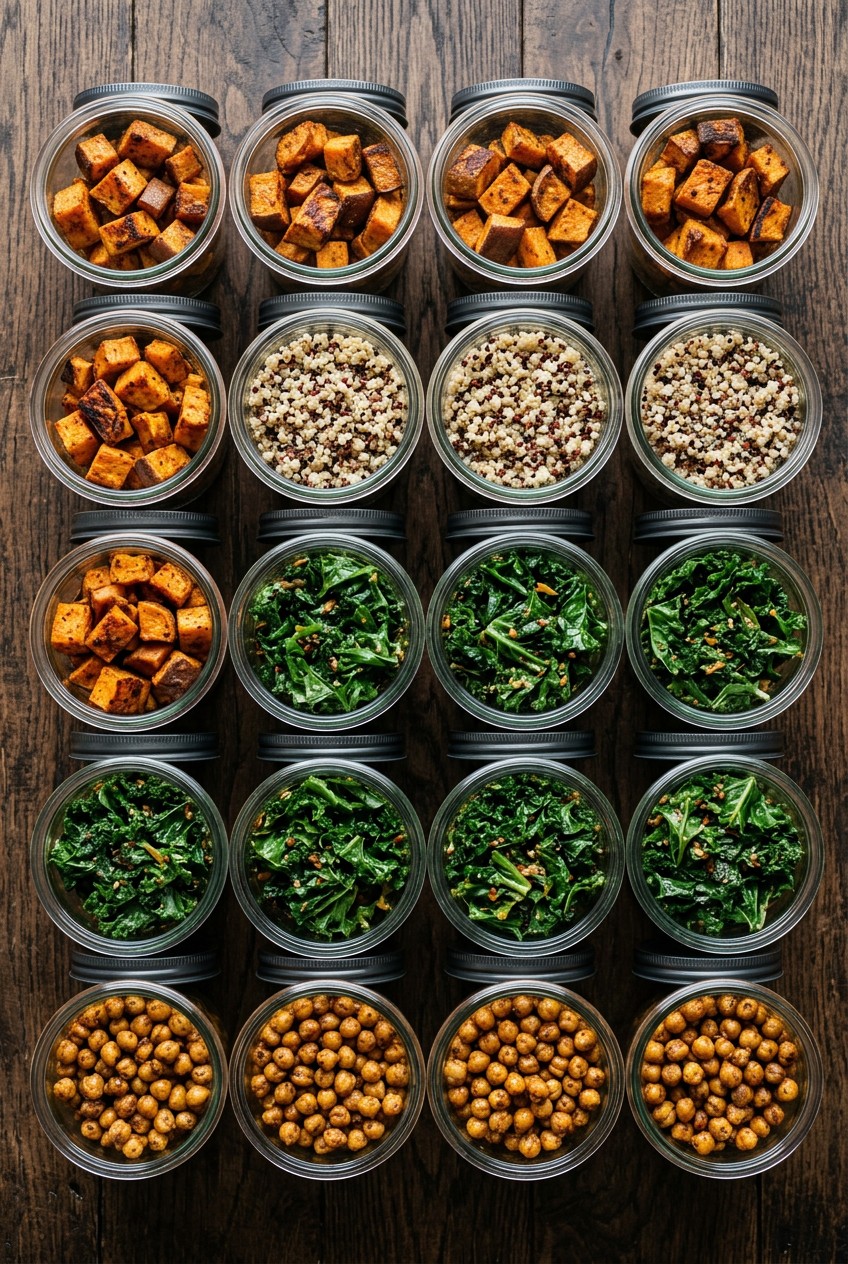
I use component cooking. Prepare large batches of individual ingredients—grains, roasted vegetables, marinated proteins, and sauces—and store them separately. This lets you mix and match. Monday might be a quinoa bowl with tofu and peanut sauce. Tuesday might be those same roasted vegetables in a wrap with hummus.
I also focus on hydration. Most think hydration is just chugging from a Stanley cup, but food plays a role. I add water-rich items right before eating. I’ll slice a fresh cucumber (96% water), celery (95% water), or bell peppers (92% water). The crunch of a cold cucumber wakes up a leftover meal. For breakfast, I use plant-based yogurts. I love Forager Project Cashewmilk Yogurt, about $2.99 at Target, paired with fresh strawberries (91% water). When assembling containers, fill only 1/4 of the plate with carbs, filling the rest with hydrating veggies and proteins.
6. Master Flavor with Quality Store-Bought Sauces

I love cooking, but I refuse to spend an hour blending five homemade sauces. It’s exhausting and creates a mountain of dishes. The secret to keeping meals exciting is leaning on high-quality, store-bought sauces.
Read the labels. Many commercial sauces are just corn syrup and cheap oil. You want less than 360 milligrams of sodium and no more than 4 grams of added sugar. I’ve tested many brands. For a smoky kick, I buy Noble Made Less-Sugar Original BBQ Sauce. It’s oil-free and costs $6.99 at Whole Foods. For heat, Yellowbird Sriracha is my favorite. It’s about $7.99 at Sprouts, with a garlicky burn that cuts through heavy grains.
For Italian, Lucini Organic Rustic Tomato Basil Sauce ($6.49) tastes incredibly fresh. For pasta salad, Gotham Greens Vegan Pesto ($7.99) delivers a rich basil punch. For grain bowls, you can’t beat Trader Joe’s Toasted Sesame Dressing for $4.49. It has a nutty bite that upgrades plain tofu. Keep these in your fridge door, and you’ll never eat a boring meal again.

VERONES 10 Pack 22 OZ Glass Meal Prep Containers
If you want something that just works, VERONES 10 Pack 22 OZ Glass Meal Prep Containers is a safe bet (18 reviews, 4.5 stars).
7. Avoid the Over-Oiling Mistake for Better Reheating
A few years ago, I packed a roasted vegetable and farro bowl. I had aggressively tossed everything in olive oil. When I pulled my container from the office fridge on Monday, I was horrified. The meal was coated in a cold, cloudy, gelatinous layer of congealed fat. It looked disgusting and tasted greasy.
Using too much oil ruins food texture after refrigeration. You don’t need a quarter cup of olive oil to roast broccoli. I use less oil or skip it entirely. I bought an air fryer for $69 at Target, and it makes tofu crispy with just a one-second spray of avocado oil.
If I’m sautéing, I use a splash of low-sodium vegetable broth or dry white wine instead of oil. You still get that satisfying sizzle, and the vegetables soften without turning into an oil slick. For bulk prep, I use a Cuisinart 14-Cup Food Processor ($229) to shred cabbage and carrots without added fats. I also use my 6-quart Instant Pot ($99 at Costco) to pressure-cook beans and stews. Cutting the oil keeps your cold meals fresh and your reheated meals textured.
8. Prioritize Food Safety and Freezer Storage

Nobody wants food poisoning. I used to leave hot soup on the stove for hours to cool. That’s dangerous. You must cool cooked food rapidly and get it into the fridge or freezer within one hour to stop bacterial growth.
I threw away my cheap, stained plastic containers two years ago. They warp, absorb smells, and leak. Invest in glass. I bought two Pyrex Simply Store Glass Food Storage Sets for $39 each at Target. The heavy clink and the tight snap of the lids give me peace of mind. Glass doesn’t absorb odors and goes straight into the microwave or oven.
Cooked grains and legumes last 4 days in the fridge. If you aren’t going to eat them by Thursday, freeze them. They last 6 months. Here’s a tip: don’t dump beans in a bag, or they’ll freeze into a rock-hard brick. Spread cooked, cooled beans flat on a parchment-lined sheet and freeze for an hour. Once they’re frozen like pebbles, transfer them to a bag. You can scoop out exact portions without an ice pick. Trust me.
Vegetarian meal prep doesn’t have to be a stressful chore. By relying on cheap proteins like dried black beans, mastering the pasta method for grains, and using quality sauces, you can keep meals under $5 per serving. Start small this Sunday. Pick two sturdy vegetables to chop and one batch of quinoa to boil. Once you experience the relief of opening your fridge on a busy Wednesday night to find healthy components, you won’t go back to takeout. If you found these tips helpful, pin this article and share it with a friend who is struggling with their lunch routine!
Frequently Asked Questions
How long do vegetarian meal prep bowls last in the fridge?
Most vegetarian meal prep components, including cooked grains, beans, and roasted vegetables, will stay fresh in airtight glass containers for up to 4 days. If you can’t finish them by day four, transfer them to the freezer.
What is the best way to keep tofu crispy for meal prep?
Always press extra-firm tofu for 30 minutes to remove excess water. Bake or air fry it with minimal oil until golden brown. Store it separately from wet sauces and reheat it in an air fryer or oven to revive the crunch.
Can I freeze cooked beans and grains?
Yes. Cooked beans and grains freeze beautifully for up to 6 months. To prevent clumping, spread them in a single layer on a baking sheet to freeze individually before transferring them to an airtight freezer bag.
Why do my prepped vegetables get soggy?
Sogginess usually happens from over-oiling before roasting or pre-chopping delicate greens too early. Stick to sturdy vegetables like broccoli and carrots, use minimal oil, and always add fresh greens or dressings right before eating.
2 thoughts on “8 Vegetarian Meal Prep for Every Budget”