What’s Inside
- The 50/25/25 Grilled Chicken and Quinoa Bowl
- Layered Mason Jar Salads (No Soggy Greens)
- Freezer-Stash Lentil Chili Using Souper Cubes
- Component Bowls with Trader Joe’s Chickpeas
- Store-Bought Rotisserie Chicken Wraps for Healthy Lunch Ideas Meal Prep
- Hands-Off Instant Pot Spaghetti Squash Bowls
- Macro-Accurate Bentgo Box Snack Lunches
- Silicone Bag Vegan Tacos for Healthy Lunch Ideas Meal Prep
Last November, I stood in the harsh fluorescent lighting of my old office breakroom in downtown Austin and realized my lunch was ruined. I pulled my flimsy plastic tub out of my canvas tote bag, only to find that the balsamic vinaigrette had completely leaked out. It pooled at the bottom of my purse, soaking into my wallet and making my laptop smell like fermented grapes for three days. If you’re looking for healthy lunch ideas and meal prep strategies that actually survive a commute, you’ve got to start with the right foundation. I ate a soggy, unseasoned pile of spinach that day, and it tasted exactly like wet cardboard. That was the moment I realized my entire approach to packing food was flawed. Learned that the hard way.
Most people get this wrong because they focus entirely on the recipes and ignore the logistics of food storage. You can cook the most flavorful chicken in the world, but if you store it poorly, it’s going to taste terrible by Wednesday. I spent months making these mistakes. I over-prepped, I used the wrong containers, and I chopped vegetables that turned to absolute mush after 24 hours. Now, I follow a very specific set of rules. I don’t prep full meals anymore. Instead, I focus on components, smart storage, and precise portions. Let’s walk through exactly how to build lunches that you’ll actually want to eat when noon rolls around.
1. The 50/25/25 Grilled Chicken and Quinoa Bowl

Before you even buy groceries, you need to fix your container situation. I bought the Rubbermaid Brilliance set for $33 at Target last October because the latches actually lock tight enough to hold soup. If you prefer glass, a Glasslock 18-piece set typically costs $30 to $45 and won’t stain when you pack turmeric rice. Once you have containers that don’t leak, you can start applying the 50/25/25 portion rule. This is how I build my base bowls without having to weigh every single ingredient on a scale.
For a balanced meal, aim for 50 percent fruits and vegetables, 25 percent lean protein, and 25 percent grains or starchy vegetables. Last Sunday at Costco, I bought a bulk pack of chicken breasts. I batch cook 1.5 to 2 lbs of chicken breast at once. I season the entire batch with 1 tablespoon of olive oil, 2 teaspoons of smoked paprika, and 1 teaspoon of garlic powder, then bake it at 400 degrees for 22 minutes. Cooked chicken remains fresh for three to four days in the refrigerator.
To assemble the bowl, I put two handfuls of mixed greens on one side of the Rubbermaid container. I add one hand-sized piece of the grilled chicken breast, which is approximately 4 to 5 ounces. Then, I add two heaping spoonfuls of cooked quinoa. The tight seal on the container keeps the greens crisp, and the separate compartments stop the quinoa from getting soggy. It’s a very straightforward formula, but it works every single time.
2. Layered Mason Jar Salads (No Soggy Greens)

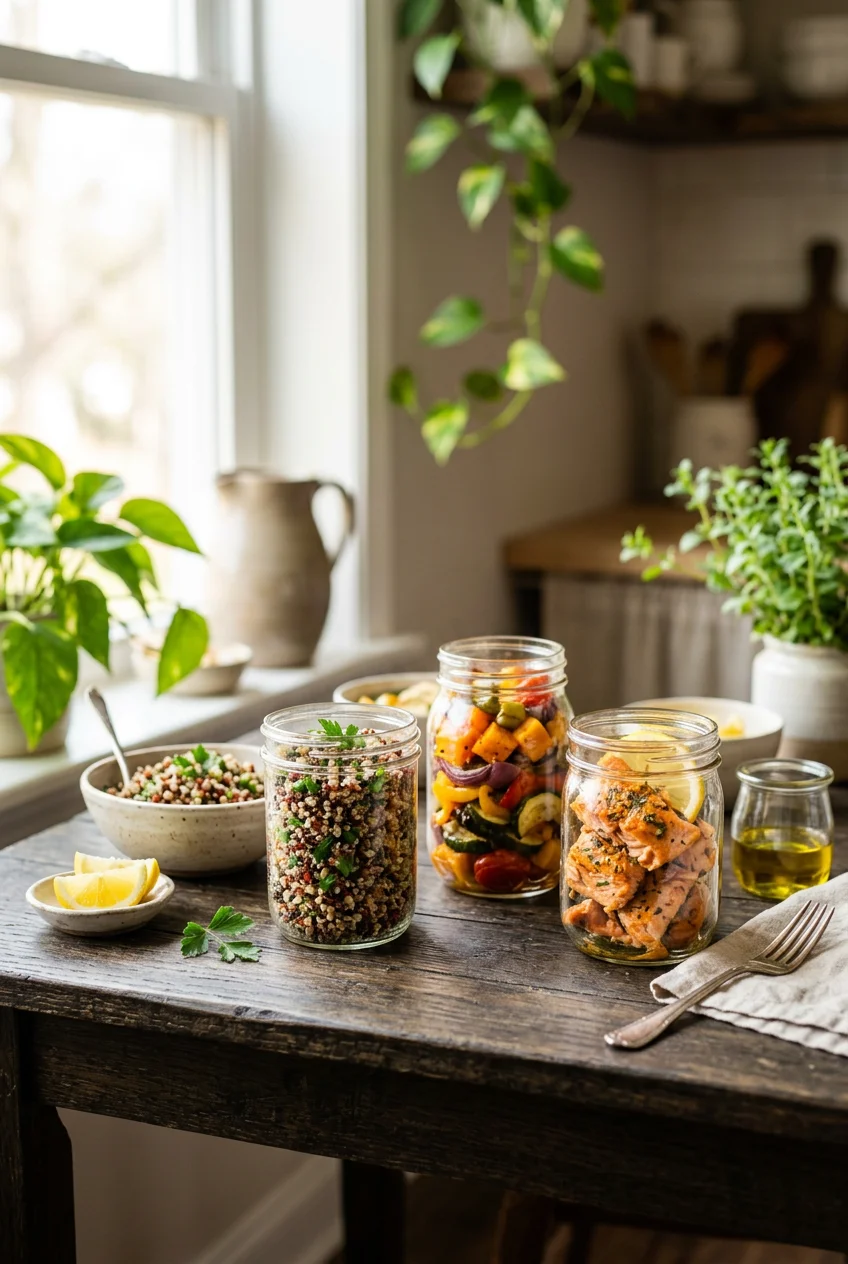
I tried packing salads in wide, flat containers for years. By Tuesday, the lettuce was always slimy, and the cucumbers were completely translucent. I finally switched to the mason jar layering method to prevent what I call soggy salad syndrome. You need wide-mouth quart-sized jars for this. The narrow ones make it impossible to get the food out without making a massive mess on your desk.
The order of ingredients is the only thing that matters here. You always start with the liquid at the very bottom. I pour exactly 2 tablespoons of dressing into the base. I picked up the Primal Kitchen Green Goddess Dressing for $7.49 at Whole Foods last week, and the avocado oil base holds up really well. Next, you add your hard vegetables. I use half a cup of diced carrots and half a cup of chopped bell peppers. These vegetables can sit in the dressing for days without breaking down. In fact, they actually taste better as they marinate.
After the hard vegetables, you add your grains or beans, followed by your protein. I usually add half a cup of black beans and 4 ounces of shredded chicken. Finally, you pack the leafy greens at the very top, as far away from the dressing as possible. When you’re ready to eat, you just shake the jar vigorously and dump it into a bowl. One major mistake to avoid: never put delicate vegetables like tomatoes or cucumbers in these jars. I pre-chopped tomatoes for a week’s worth of jars once, and they degraded so quickly that the entire batch smelled sour by Wednesday. You might also like: 10 Meal Prep Breakfast Sandwich Worth Trying
3. Freezer-Stash Lentil Chili Using Souper Cubes

Don’t limit your cooking to just three or four days of food. I used to throw away so much spoiled food on Fridays because I couldn’t eat it fast enough. Now, I embrace the freezer as my main storage tool. I make massive batches of lentil chili and freeze half of it immediately. I grabbed a one-pound bag of brown lentils for $2.49 at Sprouts specifically for this purpose. You might also like: 20 Clever Quick Lunch Ideas You Haven’t Thought Of
I used to freeze soup in regular plastic zip-top bags. They’d freeze into weird, lumpy shapes that wouldn’t fit in my freezer door, and the edges always got freezer burn. I bought a tray of Souper Cubes for $35, and it completely fixed the problem. These are heavy-duty silicone trays that freeze food into perfect one-cup blocks. I pour the warm, savory chili into the compartments, snap the lid on, and freeze it overnight. The next morning, I pop the solid blocks out and transfer them to a large freezer bag. You might also like: 10 Dinner Meal Prep for Every Budget
When I need a quick lunch, I just grab two blocks of chili and put them in a glass container. By the time lunch rolls around, they’ve thawed enough to microwave easily. The lentils hold their texture perfectly, unlike potatoes which tend to get grainy in the freezer. I also cook double batches of brown rice and freeze it flat in bags. You can break off a chunk of frozen rice, add it to the chili, and it reheats beautifully together.

buluker 4 Pack Bento Lunch Box Set 3 Compartment Food
Honestly, buluker 4 Pack Bento Lunch Box Set 3 Compartment Food Storage Containe surprised me — sturdier than it looks in the photos, and over 23 buyers gave it 4.5 stars.
4. Component Bowls with Trader Joe’s Chickpeas

I stopped making full, composed meals on Sundays. It takes too long, and I get incredibly bored eating the exact same flavor profile four days in a row. Instead, I prioritize ingredient prep. This means I cook large batches of versatile components that I can mix and match. The focus on plant-based options continues to be huge right now, so I always keep beans in the rotation.
Trader Joe’s Organic Canned Chickpeas cost $1.29 a can, and I always buy at least four. I drain and thoroughly rinse two cans on Sunday afternoon. I store them in an OXO Smart Seal Glass Container in the fridge. I aim for about 3 heaping tablespoons per serving to get a solid protein boost in my bowls. Alongside the chickpeas, I cook 2 cups of dry quinoa, which yields about 6 cups cooked. I also roast a large sheet pan of diced sweet potatoes and Brussels sprouts with a little olive oil and salt.
Having these components ready means I can build a different bowl every morning in about two minutes. On Monday, I might do quinoa, sweet potatoes, and chickpeas with a lemon vinaigrette. On Tuesday, I’ll take the same base but add a scoop of hummus and some feta cheese. It takes the pressure off Sunday prep because I’m just cooking raw ingredients rather than following a complicated recipe.
5. Store-Bought Rotisserie Chicken Wraps for Healthy Lunch Ideas Meal Prep

Sometimes you just don’t have the energy to cook raw meat, and that’s entirely fine. A surprising money and time saver is a pre-cooked rotisserie chicken. I usually grab one for $6.99 at Kroger on Sunday mornings when they’re fresh out of the oven. This is the ultimate shortcut for healthy lunch ideas meal prep when your weekend is already packed with errands.
The trick is to process the chicken the minute you get home while it’s still warm. If you put the whole chicken in the fridge and try to shred it cold the next day, the meat gets stiff and it takes twice as long. I pull all the meat off the bones, yielding about 3 to 4 cups of shredded chicken. I store it in a glass container and immediately throw the carcass away so my kitchen doesn’t smell like poultry all week. No exaggeration.
To combat meal prep boredom, I use different spices and sauces on the shredded chicken each day. I’ll take half a cup of the plain chicken and mix it with 1 tablespoon of hot sauce and a little Greek yogurt for a buffalo chicken wrap. The next day, I’ll mix a different portion with a smoky paprika rub and put it in a low-carb tortilla with spinach. You get a completely different flavor profile without having to cook multiple proteins.
6. Hands-Off Instant Pot Spaghetti Squash Bowls

I tried hacking away at a raw spaghetti squash with a chef’s knife for months. I nearly cut my thumb off twice before I realized you can just cook certain items whole. Instead of tedious chopping, I let my appliances do the heavy lifting. I utilize kitchen gadgets like an Instant Pot to significantly reduce my hands-on time in the kitchen.
I take a whole spaghetti squash, poke a few holes in it with a fork so it doesn’t explode, and put it on the trivet inside the Instant Pot with 1 cup of water. I set it to high pressure for 15 minutes. While the machine does the work, I have completely free hands to chop my hearty vegetables or clean the kitchen. When the pressure releases, the squash is soft enough to slice open effortlessly with a butter knife. I scoop out the seeds and shred the flesh into long, steaming noodles.
I divide the squash noodles into four glass containers. I top each one with half a cup of marinara sauce and three turkey meatballs. I buy the frozen turkey meatballs from Target, which cost about $6.49 for a bag. You just drop them onto the squash straight from the freezer. By the time you microwave the container at work, the meatballs heat through perfectly and flavor the squash. It’s a massive volume of food for very few calories, and it requires almost zero knife skills.

Bento Box Adult Lunch Box – 4 Pack, 5
Bento Box Adult Lunch Box – 4 Pack has been one of the most consistently praised picks in this category. 24 reviewers averaged 4.5/5.
7. Macro-Accurate Bentgo Box Snack Lunches

A common mistake is preparing too much food, which inevitably leads to food waste. I used to pack massive containers of heavy pasta, hit a midday slump at my desk, and end up throwing half of it in the trash. I switched to a snack-style lunch format using compartmentalized containers. Bentgo Prep 10-packs offer affordability and run about $15 to $22 at Walmart. The built-in dividers are perfect for portion control.
Beyond generic healthy options, I focus on personalized macro-accurate meals. I use an online calculator to figure out my protein and fat ratios, and the Bentgo compartments make it easy to hit those numbers without measuring cups. In the largest compartment, I put 2 hard-boiled eggs and 1 ounce of almonds for protein and healthy fats. In the two smaller compartments, I put half a cup of grapes and a handful of baby carrots.
This data-driven approach removes the guesswork. You know exactly what you’re eating, and the snack format keeps you from feeling sluggish at 2 PM. I only prep these boxes for two to three days in advance. If you slice apples or peel eggs for Friday on a Sunday night, they won’t taste fresh. Plan your prep around your actual schedule, and leave room for a spontaneous lunch out with coworkers on Thursday.
8. Silicone Bag Vegan Tacos for Healthy Lunch Ideas Meal Prep

I’ve been trying to reduce the amount of single-use plastic in my kitchen. I used to go through hundreds of plastic sandwich bags a year for my lunch snacks. For a more sustainable approach, I replaced them with reusable silicone bags. Stasher Bags typically cost $10 to $20 each depending on the size, and they are thick enough to go through the dishwasher without warping.
I use the half-gallon Stasher bags to store my favorite plant-based meal prep staple: lentil-walnut taco meat. I pulse 1 cup of walnuts in a food processor until they resemble ground meat, then mix them with 2 cups of cooked lentils, 1 tablespoon of cumin, and 1 teaspoon of chili powder. I dump the entire mixture into a large silicone bag. It takes up almost no space in the fridge because the bag lays completely flat on the shelf. Took me years to figure out that trick.
When I pack my lunch for the day, I scoop half a cup of the lentil mixture into a smaller container. I pack two corn tortillas in a sandwich-sized Stasher bag to keep them from drying out. This is one of the best healthy lunch ideas meal prep solutions because the lentil mixture actually tastes better on day three after the cumin and chili powder have had time to fully absorb into the walnuts.
Finding a routine that fits your actual lifestyle takes a little trial and error. Skip the fat-free dressings that taste like chemicals, invest in containers that actually lock, and stop trying to prep seven days of food at once. If you start by just prepping three days of versatile components, your work week will feel significantly less chaotic. I highly recommend trying the mason jar salad method first if you’re tired of soggy greens. Pin this guide for your next Sunday prep session, and let me know which container setup ends up working best for your commute.
Frequently Asked Questions
How long do meal prepped lunches last in the fridge?
Most cooked proteins like chicken and roasted vegetables remain fresh for three to four days in airtight containers. For maximum freshness, only prep meals for Monday through Wednesday, or utilize your freezer for longer storage.
What is the best container for healthy lunch ideas meal prep?
Glass containers with locking lids, like Glasslock, or high-quality BPA-free plastics like Rubbermaid Brilliance are ideal. They prevent leaks during your commute and keep ingredients like greens and grains separated and fresh.
How do I keep my meal prep salad from getting soggy?
Use the mason jar layering method. Pour your dressing at the very bottom, add hard vegetables like carrots next, follow with proteins and grains, and pack the delicate leafy greens at the very top.
What is the 50/25/25 portion rule?
It is a simple visual guide for balanced meals: fill 50 percent of your container with fruits and vegetables, 25 percent with lean protein, and 25 percent with complex carbohydrates or starchy vegetables like quinoa or sweet potatoes.
